Metalworking CCNL in Italy: hours, overtime, leave and hourly divisor
Italy's metalworking industry CCNL after the 22 Nov 2025 renewal: 40-hour week, multi-week hours, overtime, 104 hours of PAR leave, hours account, divisor 173.
Published 5 min read
The collective agreement (CCNL) for the engineering and plant-installation industry (Federmeccanica, Assistal, Fim, Fiom, Uilm) applies in factories, workshops and plant-installation firms. For anyone tracking hours only a few articles matter, but the renewal has changed some numbers.
Which text we read
The agreement in force is the renewal signed on 22 November 2025, valid until 30 June 2028, which updates the text of 5 February 2021. We read the draft agreement (ipotesi di accordo) of 22 November 2025, which reproduces the amended articles, and for the rest the text of 5 February 2021 as reproduced by Studio Bergonzini. The unions lifted their reservation on 23 February 2026. After signing, Federmeccanica corrected some typos in the final text: always check the text in force.
Normal hours and multi-week hours
Art. 5, Section 4, Title III.
- 40 hours a week, also as an average over a period of up to 12 months in the cases provided for. The law sets the same 40 hours and lets collective agreements shorten them or refer them to the annual average (Legislative Decree 66/2003, art. 3).
- Orario plurisettimanale (multi-week averaging of hours): the average stays at 40, but for production reasons the company may ask for up to 96 extra hours a year (80 in the 2021 text), with a maximum of 48 hours in any week. This needs a prior review with the RSU (Rappresentanza sindacale unitaria, the workplace union body) and at least 15 days’ notice, cut to 5 for sudden needs, with recovery within three months.
- Pay stays at normal-hours level in both long and short weeks. Hours beyond the weekly 40 carry a premium of 15% Monday to Friday and 25% on Saturday (20% and 30% for sudden needs). From the 81st hour the text adds a further 8% “all-inclusive” increase: have your consultant check how it applies.
Overtime and the time bank
Art. 7, Section 4, Title III. Overtime is work after the daily schedule set by the company, to be kept within 2 hours a day and 8 a week. The annual cap per worker is 200 hours, 250 in companies of up to 200 employees and 260 for maintenance, installation and assembly: the renewal confirms them. For up to 80 hours a year, the “exempt quotas” (quote esenti) need no information to or prior agreement with the RSU, with 24 hours’ notice.
| Non-shift work | Premium |
|---|---|
| Weekday overtime, first two hours | 25% |
| Weekday overtime, later hours | 30% |
| Holiday overtime | 55% |
| Night overtime | 50% |
| Night holiday overtime | 75% |
Shift workers, compensatory rest and the 10 pm to 6 am band have different percentages in the same article. Percentages are applied to the hourly pay. With the time bank (banca ore) the employee decides: if they do not ask for time off by the following month, the overtime is paid. For banked hours the premium is 50% of the overtime one (see time bank and overtime).
Paid annual leave and the hours account
Also art. 5. On the payslip it is often called ROL: 13 days of 8 hours, i.e. 104 hours a year, of which 72 for working-time reduction and 32 for the abolished holidays, reduced pro rata for part years (see ROL and ex-holiday leave). The contract calls it permessi annui retribuiti (PAR). The renewal changes how it is used:
- up to 7 days (previously 5) can be taken collectively, after review with the RSU, normally by September; the rest is individual;
- an individual request needs 7 days’ notice (previously 10) and can be taken in blocks of 2 hours (previously 4), outside rotating shifts;
- leave not taken in the year goes into the individual hours account (conto ore individuale) for another 24 months. In the first quarter of the second year the company can ask the employee to schedule, by 30 June, the hours about to expire; at the end, remaining hours are paid out at the pay then in force.
Divisor and sickness
For the hourly rate, divide monthly minimums, seniority steps and other monthly pay by 173, adding hourly items such as incentives and allowances (art. 3, Section 4, Title IV). The 2025 draft agreement does not change it: see hourly rate and divisor.
For sickness, the short protection period (comporto breve) is 183, 274 or 365 calendar days, for service up to 3 years, 3 to 6 and over 6, counted over the previous three years. A longer period applies in special cases (art. 2, Section 4, Title VI). From 1 January 2026, workers with a certified disability get a further 30, 45 or 60 days. Talk to your consultant before any dismissal for exceeding it.
Example: overtime and leave in a month
Non-shift employee. Monthly pay of €1,903 (made-up figure), divisor 173: hourly rate €11.00.
| Item | Calculation | Gross amount |
|---|---|---|
| 6 weekday hours (first two hours of each day) | 6 × €11.00 × 1.25 | €82.50 |
| 2 hours of holiday overtime | 2 × €11.00 × 1.55 | €34.10 |
| 16 hours of PAR paid out when the hours account ends | 16 × €11.00 | €176.00 |
Indicative amounts: your consultant applies the real items. To run your own numbers use the overtime calculator.
Mistakes to avoid
- Using the 2021 or 2016 text. Multi-week hours and PAR rules have changed: check the edition.
- Counting overtime from the 41st hour. The agreement measures it after the daily schedule.
- Letting hours expire in the hours account. The 24 months run from the year they accrue.
- Using the wrong divisor. Here it is 173, not 168.
How Chrono Desk does it
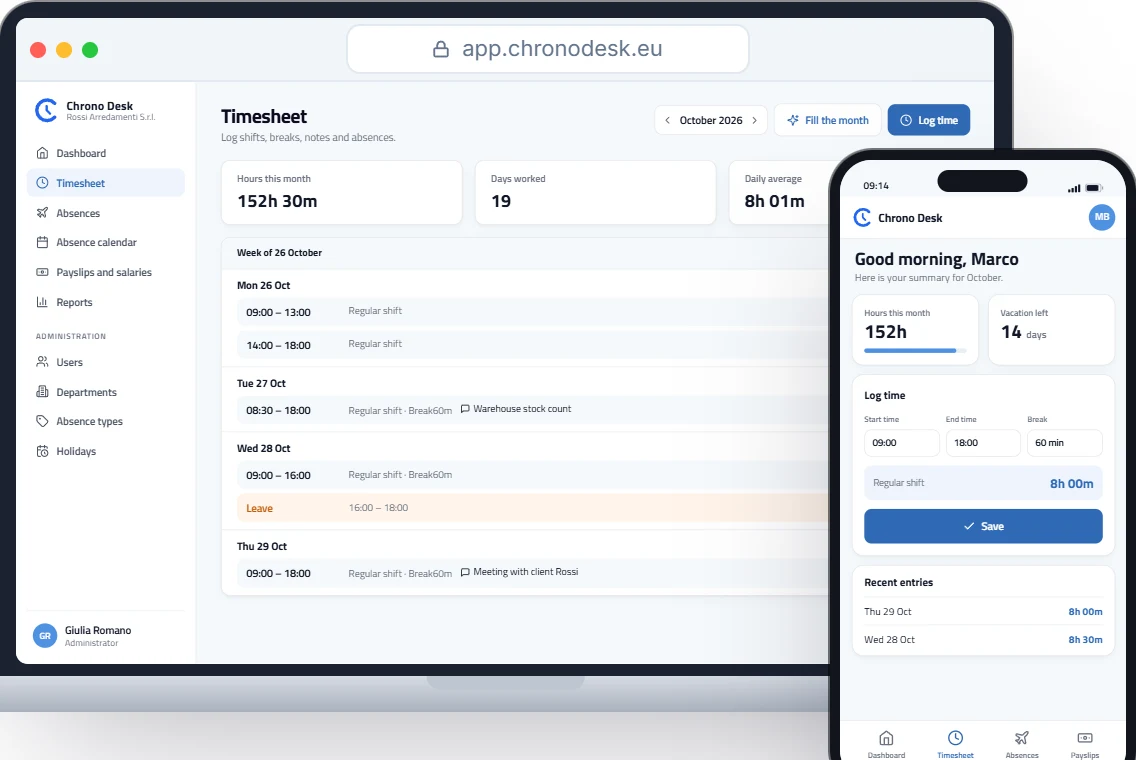
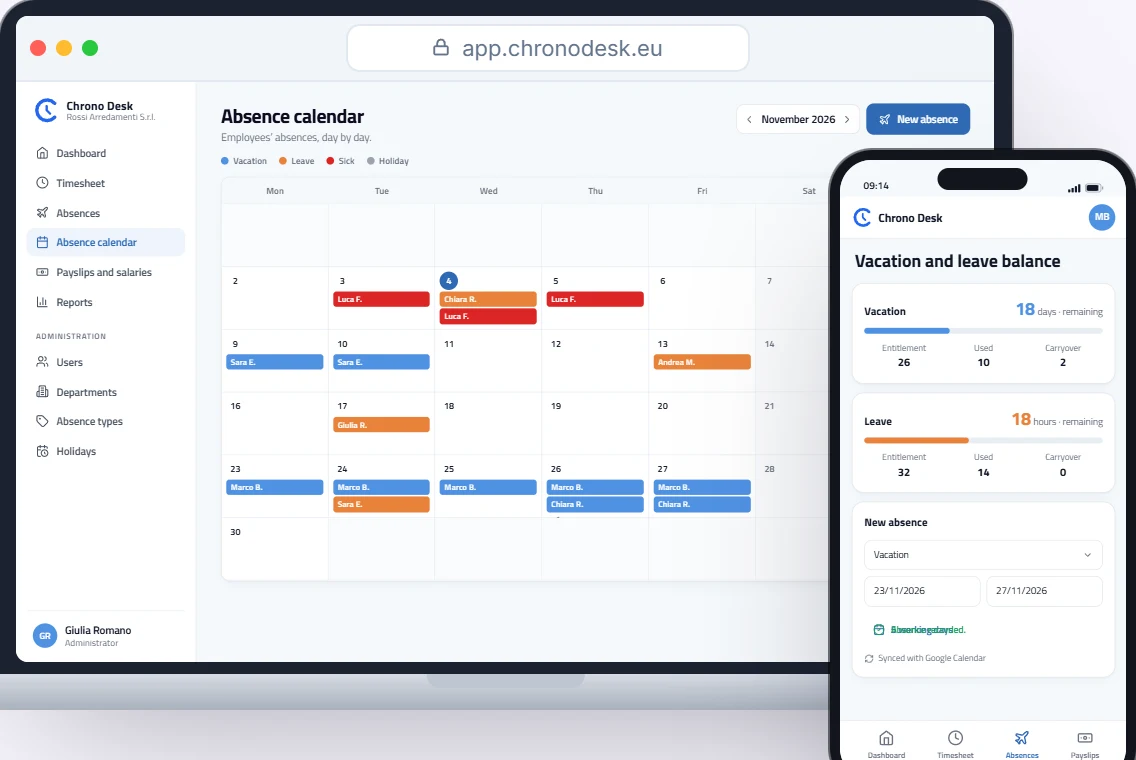
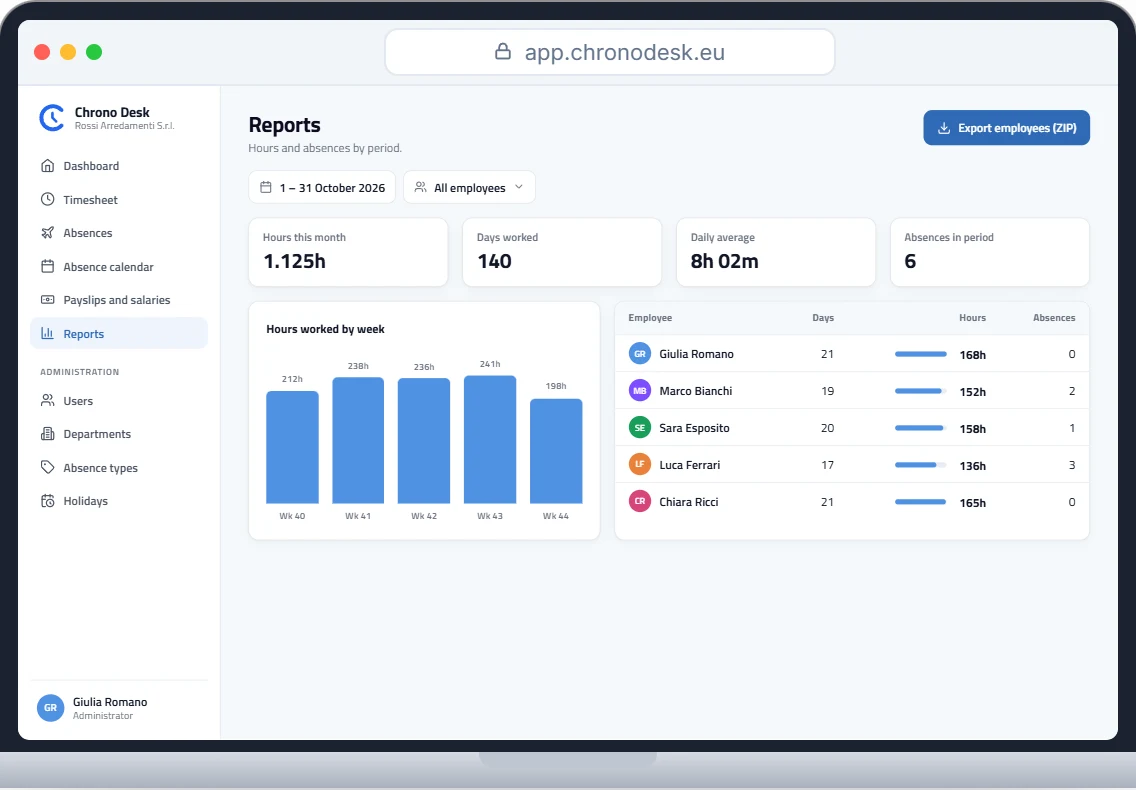
With Chrono Desk hours are recorded every day with start, end and break, so you keep regular and overtime hours apart. With vacation and leave you create PAR in hours, with balance and carryover, while the report gives your consultant hours and absences per employee, from which they apply the premiums. The sector overview is on the manufacturing page.
Want to see how it works with your collective agreement? Talk to us.
This guide is for information only and does not replace advice from your payroll consultant or the rules of your collective agreement.