Overtime in Italy: limits, premiums and how to calculate it
What counts as overtime in Italy, how many hours the law allows, who sets the premiums and how to calculate overtime pay, with a step-by-step example.
Published 3 min read
Overtime is one of the payslip items that changes most from month to month, and one of the most disputed. To pay it correctly you need two things: to know which hours really are overtime, and to know the rules of the applicable collective agreement (CCNL). Here are the legal limits, how premiums work and how the calculation is done.
What counts as overtime
Under Legislative Decree 66/2003, overtime (lavoro straordinario) is work done beyond standard hours. The legal standard is 40 hours a week (art. 3), but the collective agreement can set fewer: in that case the contract’s hours apply.
Don’t confuse overtime with the additional hours (lavoro supplementare) of part-timers: extra hours worked by a part-time employee, up to full-time hours, are additional hours and follow their own rules in the agreement.
How much overtime is allowed
The law sets two limits, which apply together:
- 48 hours a week on average, overtime included, over a 4-month reference period; the collective agreement can extend it to 6 or 12 months (12 only for objective, technical or organisational reasons, art. 4);
- 250 hours of overtime a year, if the collective agreement sets no other limit (art. 5).
The 11 consecutive hours of rest every 24 hours and the weekly rest always apply. That is why a working day, overtime included, cannot exceed 13 hours.
Overtime should be kept limited. If the collective agreement does not regulate it, it requires an agreement between employer and employee.
The collective agreement sets the premiums
The law says overtime must be paid with pay premiums, but it does not set the percentages: collective agreements do. The premium usually depends on when the work is done:
| Overtime type | What changes |
|---|---|
| Weekday daytime | The lowest premium |
| Night | A higher premium, for hours in the agreement’s night band |
| Public holiday | A higher premium, for hours on public holidays |
Many agreements also raise the premium beyond a set number of weekly hours. The agreement can also provide time off in lieu as an alternative to, or in addition to, the premiums (an hours bank: see our guide to the time bank).
How overtime pay is calculated
The calculation has three steps.
- Hourly rate. If you don’t know it, divide the monthly pay by the agreement’s hourly divisor: for example 168 in the Confcommercio Terziario CCNL (40 hours), 173 in the metalworking industry CCNL.
- Value of each hour. Hourly rate × (1 + premium).
- Total. Add up the hours of each type, each with its own premium.
An example with indicative figures: monthly pay of €1,800 and a divisor of 168 give an hourly rate of about €10.71. With 8 hours of weekday overtime at 15%, the pay is 8 × 10.71 × 1.15 = about €98.57 gross.
To run the numbers for your case, use our free overtime pay calculator: enter the pay, the hours and your agreement’s premiums.
Common mistakes
- Counting breaks as overtime, or time before the shift starts without authorisation.
- Not separating night and holiday hours from weekday ones: they carry different premiums.
- Losing track of yearly hours, and going past the agreement’s limit or 250 hours without noticing.
- Rebuilding everything at month end from messages and spreadsheets, instead of recording hours day by day.
How Chrono Desk does it
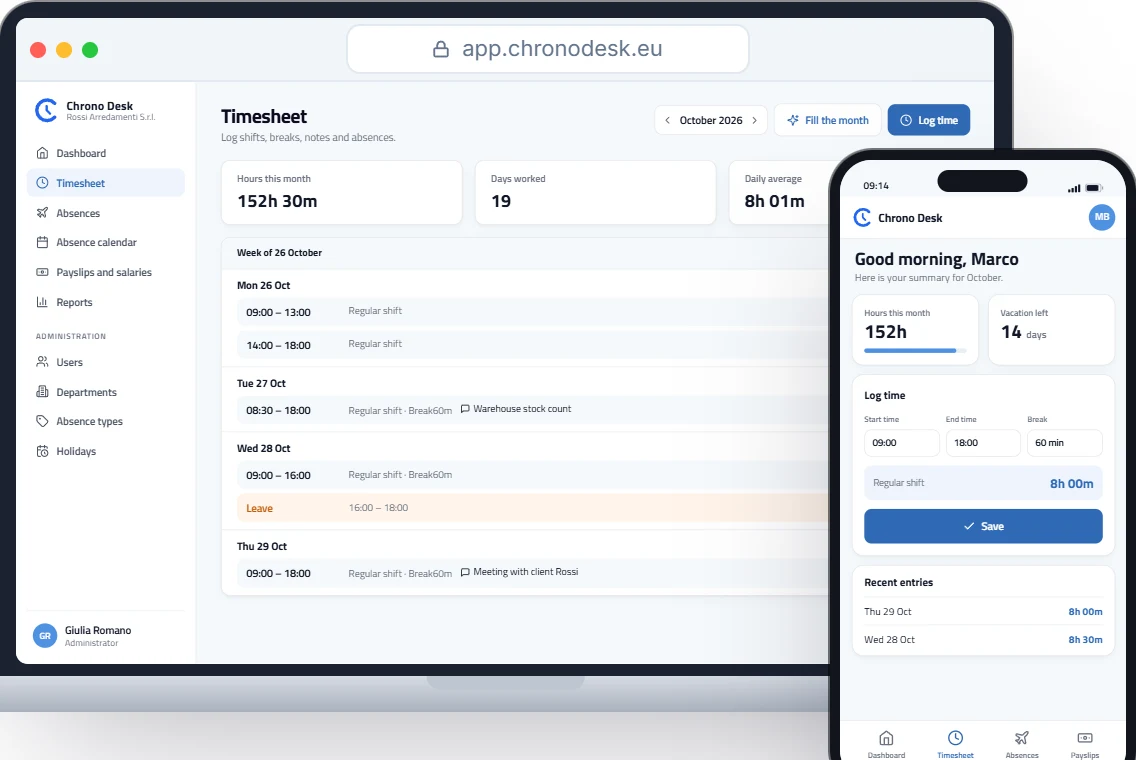
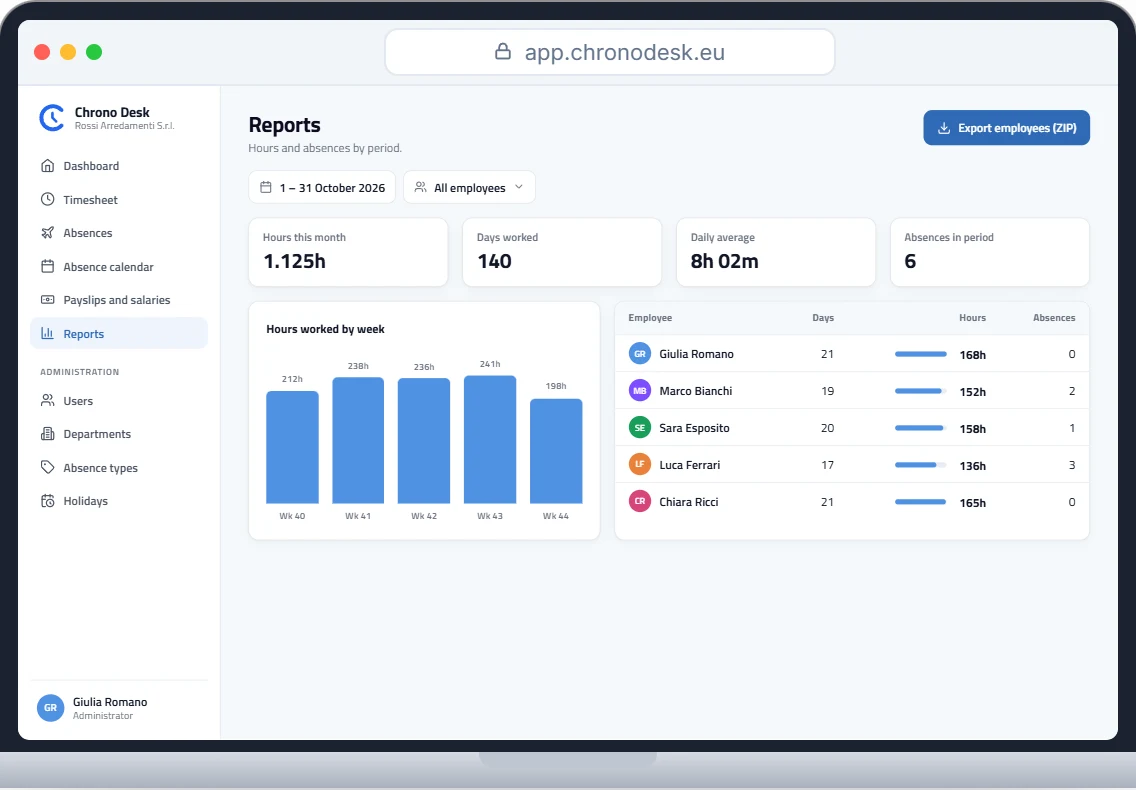
With Chrono Desk, hours are recorded every day in the online timesheet, with start, end and break. At month end the report separates regular hours from hours beyond the contract, by employee and by period, and the payroll consultant downloads the data ready for payslips.
To see it with your company’s data, request a demo.
This guide is for information only and does not replace advice from your payroll consultant or the rules of the applicable collective agreement.