Company closure and collective vacation in Italy: who decides, notice and what if balances run short
August shutdown in Italy: who sets the vacation period, when to tell employees, what to do if accrued vacation runs short and how to record the closure.
Published 5 min read
Every summer many Italian companies close for a few weeks and put everyone on vacation together. It is a lawful choice, but it raises practical questions: who decides the period, how it must be communicated and what happens to people without enough accrued vacation. Here is what the official sources say and how to record the closure.
Who decides when vacation is taken
Under the Civil Code (art. 2109), vacation is taken, if possible in one block, at the time the employer sets, taking into account the needs of the business and the worker’s interests. The Ministry of Labour confirms it: the employer may provide both for scheduling workers’ vacation and for closing the plant for a set period (ruling no. 20/2016, an interpello, i.e. an official reply to a query).
Collective vacation (ferie collettive) means all workers are on vacation in the same period, with at least a partial halt in activity. A paper by a Ministry official, which reflects the author’s own view and does not bind the administration, says closure periods must not be set “with absolute arbitrariness” and that, without a rule or a contractual provision on the number of days, the choice rests with the employer as an expression of organisational power.
The role of the CCNL and the legal minimums
The law sets no cap on closure days, but the collective agreement (CCNL) or a company agreement may say more about length, periods and procedure: check yours before deciding. The minimums of Legislative Decree 66/2003, art. 10, still apply: at least four weeks of vacation a year, two of them in the year of accrual (consecutive if the worker asks) and the other two within 18 months of the end of that year. If an employee asks for two consecutive weeks, the request must be made in good time so the company can balance everyone’s needs (Ministry of Labour circular no. 8/2005). See Vacation and leave in Italy and Unused vacation in Italy.
How and when to tell employees
Art. 2109 of the Civil Code says the employer must notify the worker in advance of the period set for vacation. The rule gives no number of days’ notice: if your CCNL or a company agreement sets one, that applies. In any case it is wise to notify in writing and well ahead, for example in the vacation plan at the start of the year, and keep a record.
If the closure is longer than accrued vacation
This is the typical case of a recent hire or someone who has already used their vacation. There is no single rule: it depends on the CCNL and agreements. The tools to check, to be agreed in writing with the worker and your payroll consultant, are:
- ROL and ex-holiday leave, if the agreement lets you use them in that period: see ROL and ex-holiday leave in Italy.
- Time bank (banca ore), if provided for by the CCNL or an agreement: see Time bank in Italy.
- Vacation not yet accrued or unpaid leave, only if the agreement allows it or the worker agrees.
- Income-support schemes: for the FIS wage fund, INPS has stated that during a collective-vacation closure no worker can receive its benefits (circular no. 130/2017). Do not count on it to cover the closure, and ask your consultant.
The Ministry notes in general that when the obstacle to working comes from the business, the employer remains bound to pay wages: that is why the period should not be treated as unpaid without an agreement.
Example: a June hire and a three-week closure
A full-timer on 40 hours, four weeks of vacation a year (160 hours), hired on 1 June; the company closes for three weeks in August. This is an illustrative case, with no ROL or time bank and accrual of one twelfth a month.
| Step | Calculation | Result |
|---|---|---|
| Closure hours | 3 weeks × 40 hours | 120 hours |
| Vacation accrued by end of August | 160 ÷ 12 × 3 months | 40 hours |
| Hours to cover | 120 − 40 | 80 hours (10 days of 8 hours) |
These 80 hours must be covered with one of the tools above, chosen with your payroll consultant before the closure.
Part-timers and special cases
- Part-time: closure hours depend on each person’s schedule, which is why tracking vacation in hours helps. For vertical part-time (working only some days) the day count depends on how the schedule is arranged and on the CCNL: see Part-time work in Italy.
- Sick leave: if the worker was already sick before the vacation began, according to the Ministry they normally stay on sick leave until recovery and take the vacation later.
- Law 104: the employer cannot refuse the three monthly days of leave during scheduled vacation or a production shutdown (ruling no. 20/2016): see Law 104 leave in Italy.
Mistakes to avoid
- Setting the closure without checking the CCNL. It may have rules on period and notice.
- Telling people verbally. Without a written record you cannot show you notified the period.
- Not checking balances before August. People without enough vacation need handling beforehand, not in September.
- Recording the closure outside the timesheet. The single employment register (LUL) lists hours and absences day by day, with unambiguous codes (Decree-Law 112/2008, art. 39).
How Chrono Desk does it
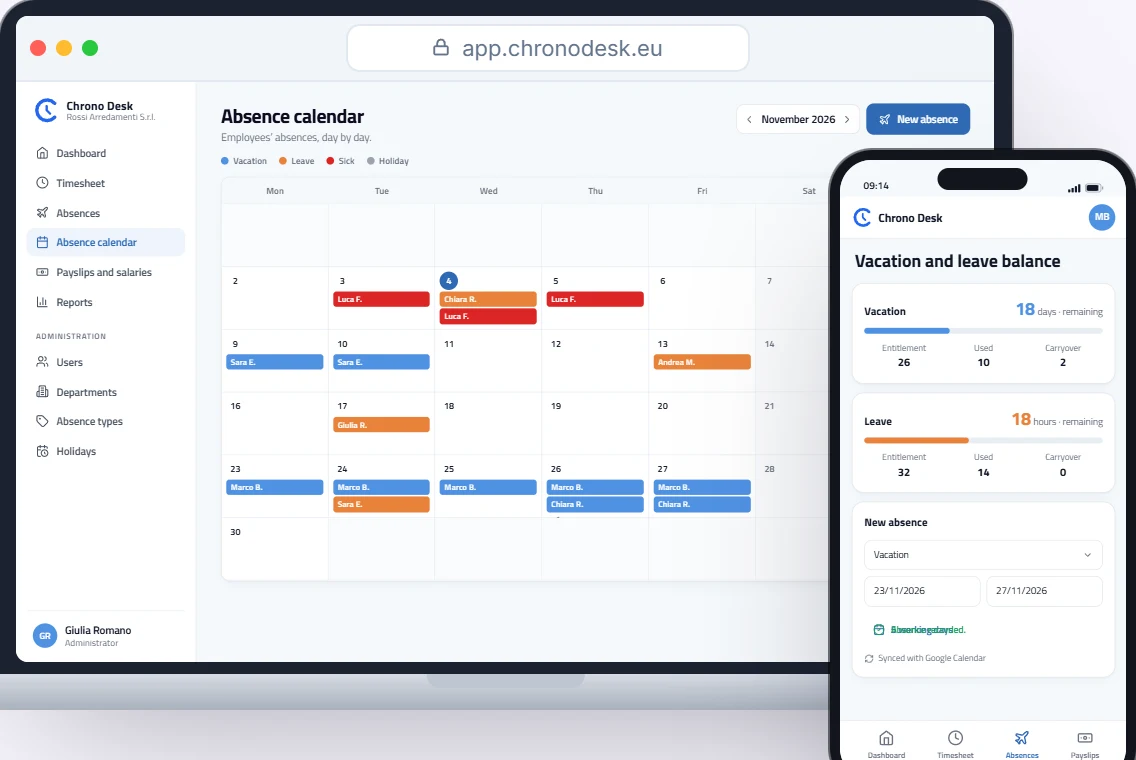
In Chrono Desk each employee adds an absence by choosing type and dates: the balance updates and the absence appears in the team calendar, where the manager sees who is away and the payroll consultant sees the whole company. Absence types are tracked in days or hours, handy for part-timers, ROL and leave, and company holidays are separate days that do not count as vacation. Absences live in the same place as the timesheet.
Want to see how it fits your collective agreement? Talk to us.
This guide is for information only and does not replace advice from your payroll consultant or the rules of your collective agreement.