Time bank (banca ore) in Italy: how it works and what CCNLs say
What the banca ore (time bank) is, what Legislative Decree 66/2003 says, who decides, what two CCNLs provide and a worked example with banked overtime hours.
Published 4 min read
The banca ore (time bank, or hours bank) is an account of hours: instead of paying some extra hours straight away, the company banks them and the employee takes them later as paid time off. The rules sit almost entirely in collective agreements, not in the law. Here is what the law says, what two national collective agreements (CCNL) provide and how to keep the numbers straight.
What the law says
Legislative Decree 66/2003 never uses the words “banca ore”, but it is the starting point. Art. 5(5) says overtime must be counted separately and paid with the premiums set by collective agreements, which may allow workers to take compensatory rest (riposi compensativi), instead of or on top of the premiums, for the overtime worked.
So a time bank exists only if a collective agreement provides for it: the CCNL and, in some cases, a company agreement. Hours stay overtime even when taken as rest: the legal limits apply to the work done.
Who decides: two CCNL examples
The law does not say who chooses between pay and rest. Two agreements, read in their text:
- Metalworking industry (CCNL of 26 November 2016, text of 5 February 2021, Section IV, Title III, art. 7). The time bank covers all overtime and the employee decides: if they don’t ask for rest by the following month, the overtime is paid. For hours going into the bank the premium is 50% of the overtime premium. At the end of the period, hours still banked are paid at the pay rate in force.
- Retail, distribution and services (Confcommercio, Testo Unico of 3 February 2026, arts. 140-144). Here the bank does not collect overtime, which is paid by the following month (art. 153), but part of the flexibility hours: under the arrangements that take the week up to 48 hours in peak periods (arts. 141-142), 50% of the hours to be recovered go into the bank and are used as compensatory rest. Time off is taken in blocks of 4 or 8 hours with 5 days’ written notice, and at 31 December the company gives the employee an individual statement. Hours not taken are paid with the overtime premium by 31 December of the following year.
Other CCNLs differ: check the current text of yours.
Time bank, ROL, vacation and recovered hours
| Item | Where it comes from | How it is used |
|---|---|---|
| Time bank | Banked overtime or flexibility hours | Paid time off, CCNL rules |
| ROL (paid leave hours) | Accrue every year under the contract | Leave in hours or blocks of hours |
| Vacation (ferie) | Statutory: at least 4 weeks (art. 10) | Not replaceable by a payout, except at termination |
| Recovered hours | Extra hours in one period, fewer in another | Shorter hours in quiet periods |
What happens to the balance when employment ends
Art. 5 does not regulate it and the two agreements read do not address it explicitly. Normally a positive balance, being work already done, is paid out with the final settlement: have your payroll consultant check the balance.
Timesheet and payslip
The Libro Unico del Lavoro (single employment register, art. 39, Decree-Law 112/2008) requires a daily calendar with hours worked, overtime, absences, vacation and rest, with overtime shown separately. Hours going into the bank must therefore be kept apart from regular hours. Each month you need three numbers: banked, taken and balance. Where the balance shows on the payslip is up to the CCNL and the payroll office.
A worked example
An illustrative case, not a legal rule: a company agreement lets overtime be banked and pays the premium at once. With monthly pay of €1,800 and a divisor of 168, the hourly rate is about €10.71. In March the employee works 8 hours of weekday overtime at 15%.
- Paid at once: 8 × 10.71 × 1.15 = about €98.57 gross.
- Banked: in March only the premium is paid, 8 × 10.71 × 0.15 = about €12.86. The 8 hours, worth €85.71, go into the bank: from a 6-hour balance in February, the end of March shows 14.
In May the employee takes a full 8-hour day off: pay doesn’t change and the balance drops back to 6. If the hours are never taken, the CCNL provides for payment (here €85.71), for a total of €98.57.
Common mistakes
- Banking hours without a written basis in the CCNL or an agreement.
- Missing deadlines, such as 31 December of the following year.
- Mixing paid overtime and banked hours in one total.
- Confusing the time bank with ROL and vacation, which have separate balances and rules.
How Chrono Desk does it
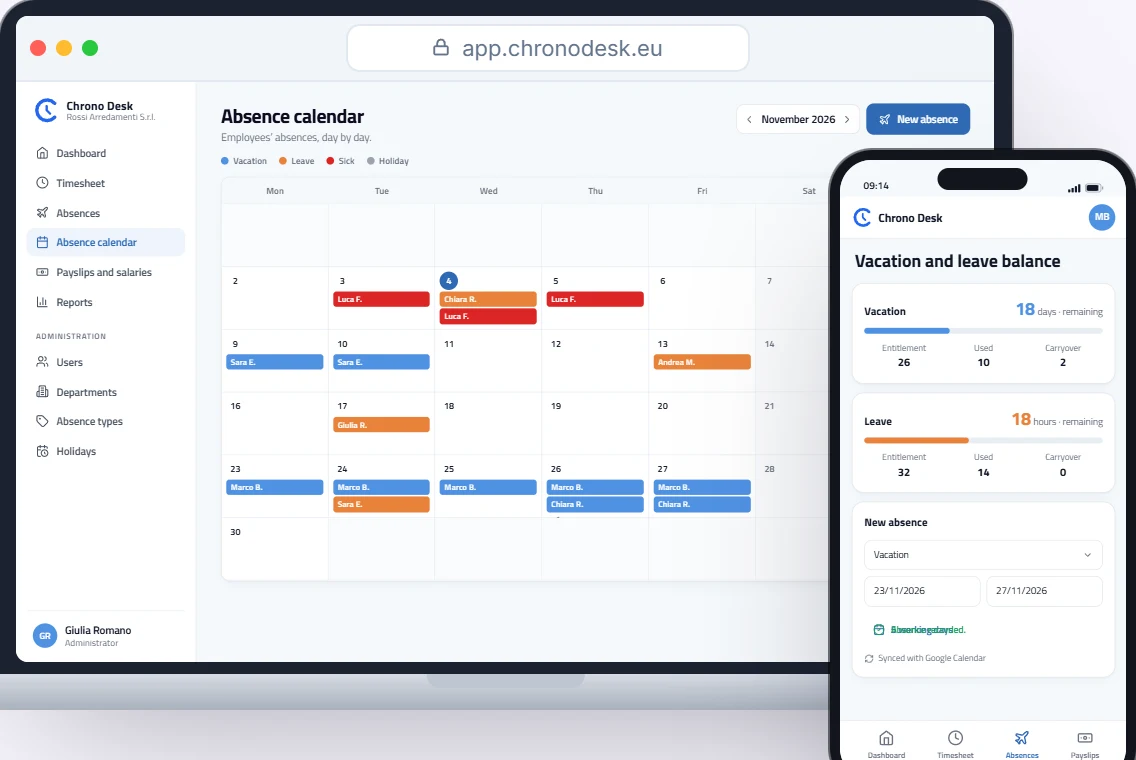
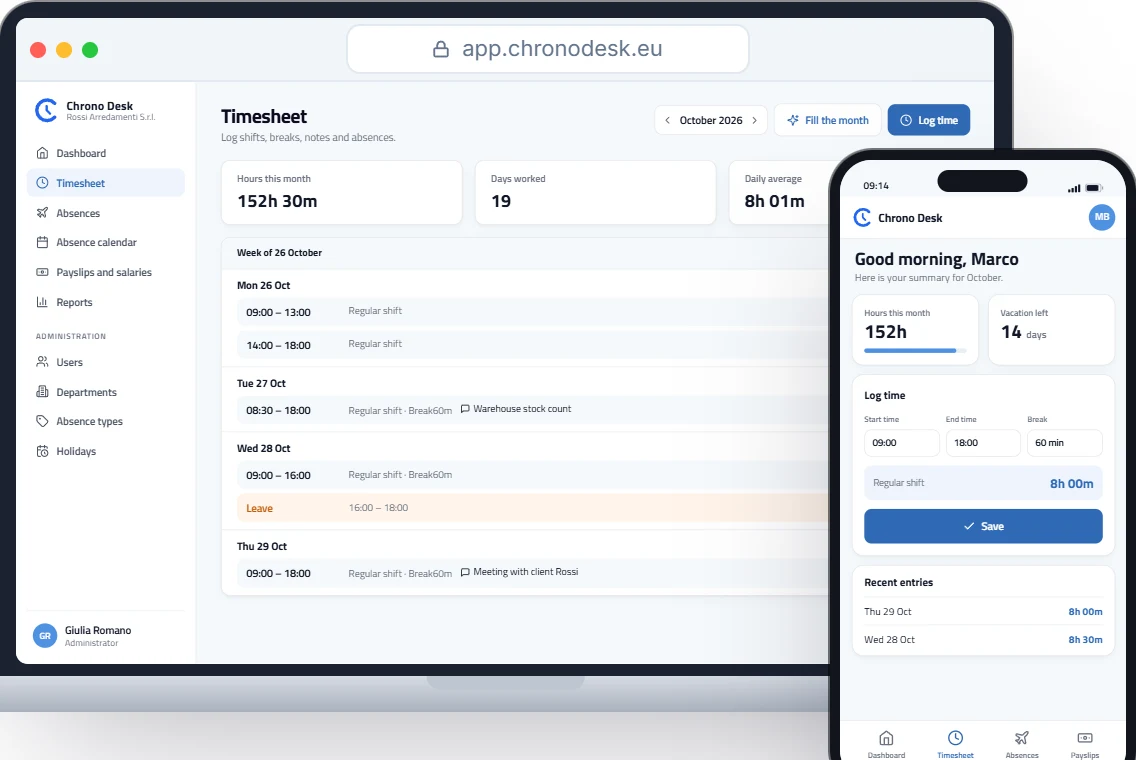
With Chrono Desk, hours are logged every day in the online timesheet, with start, end and break, and a note on any shift for exceptions. The report shows days, total hours and daily average per employee, and the payroll consultant downloads one CSV per employee in a single ZIP.
To see it with your company’s data, request a demo.
This guide is for information only and does not replace advice from your payroll consultant or the rules of the applicable collective agreement.