Hourly rate and hourly divisor in Italy: how to calculate them
How to get the hourly rate from monthly pay with the CCNL's divisor, or from annual gross pay (RAL), why divisors differ and how part-time works.
Published 4 min read
Knowing what an hour of work is worth matters for overtime, unused vacation, hourly leave and deductions. But the figure is not the same everywhere: it depends on the collective agreement (CCNL) and on which pay element you start from. Here is how the hourly rate is calculated and where quick calculations stop working.
From monthly pay: the hourly divisor
The formula is simple: hourly rate = monthly pay ÷ hourly divisor (divisore orario). The divisor is a conventional number set by the CCNL, not by law. Two examples we checked in the agreements’ texts:
- Retail, distribution and services CCNL (Confcommercio): 168 for staff with a normal week of 40 hours, 182 for 42 hours, 195 for 45 hours (art. 215). For the daily share the divisor is 26 (art. 214).
- Metalworking industry CCNL (plant installation included): 173 (Section 4, Title IV, art. 3).
Other agreements use other numbers: always check the current text of your CCNL. With our free hourly rate calculator you enter pay and divisor and get the result.
Why divisors differ
There is no single “right” divisor. Arithmetic gives a reference point: 40 hours × 52 weeks ÷ 12 months = 173.33. The metalworkers’ 173 comes close, while the Retail 168 is a choice made by the agreement and does not match that average.
The 26 used for the daily share is usually explained by the Monday-to-Saturday days in a month, but it remains a value set by the CCNL.
Base pay, normal pay and actual pay
These are three different bases, and the CCNL says which one applies to each item.
- Base pay (paga base, the tabular minimum): the main item in the agreement’s pay tables.
- Normal pay (normale retribuzione): in Retail it includes base pay, cost-of-living allowance, seniority increments and other contractual elements (art. 210).
- Actual pay (retribuzione di fatto, or globale di fatto): adds other continuous elements and excludes, for example, expense reimbursements, overtime pay and one-off payments (art. 212).
Also in Retail, vacation is paid at actual pay (art. 164) and an overtime hour is paid at actual pay, with the premium calculated on normal pay (art. 152). For severance pay (TFR), art. 2120 of the Civil Code applies: unless collective agreements say otherwise, all sums paid on a non-occasional basis count, expense reimbursements excluded. For an exact figure, your agreement tells you the base.
From annual pay (RAL): the 52-week calculation
Starting from the RAL (retribuzione annua lorda, annual gross pay) you use RAL ÷ (weekly hours × 52). It is a calculation convention, not a legal rule. It has an important limit: the RAL includes the 13th and 14th month and hours that are paid but not worked (vacation, holidays), so the result is an average per paid hour and comes out higher than the divisor method. It suits comparisons and budgets, but it does not replace the CCNL’s base for overtime.
Part-time: pay is scaled, the hourly rate is not
For part-timers, pay is scaled to the shorter working time (art. 7, Legislative Decree 81/2015), but the hour is worth the same as for a full-timer. In Retail the part-time hourly share is the full-time monthly pay divided by the full-time divisor (art. 91). So do not divide the reduced monthly pay by the full divisor: in the calculator, start from the full-time monthly pay.
A worked example
A Retail employee, 40 hours a week, €1,800 gross a month, 14 monthly payments, divisor 168.
- Hourly rate: 1,800 ÷ 168 = about €10.71.
- Daily share: 1,800 ÷ 26 = about €69.23.
- From the RAL: 1,800 × 14 = €25,200; 25,200 ÷ (40 × 52 = 2,080) = about €12.12, 13% more, because it includes the 13th and 14th month and hours not worked.
- Part-time at 20 hours: monthly pay €900, but the hourly rate is still 1,800 ÷ 168 = €10.71. Dividing 900 by 168 would give €5.36, which is wrong.
The €10.71 rate is the same as in the example of our overtime guide.
Common mistakes
- Using the same divisor for every CCNL: 168 and 173 are not interchangeable.
- Dividing a part-timer’s monthly pay by the full-time divisor.
- Mistaking RAL ÷ 2,080 for the contractual hourly rate.
- Starting from base pay alone when the CCNL calls for actual pay.
- Starting from take-home pay: the hourly rate is calculated on gross pay.
How Chrono Desk does it
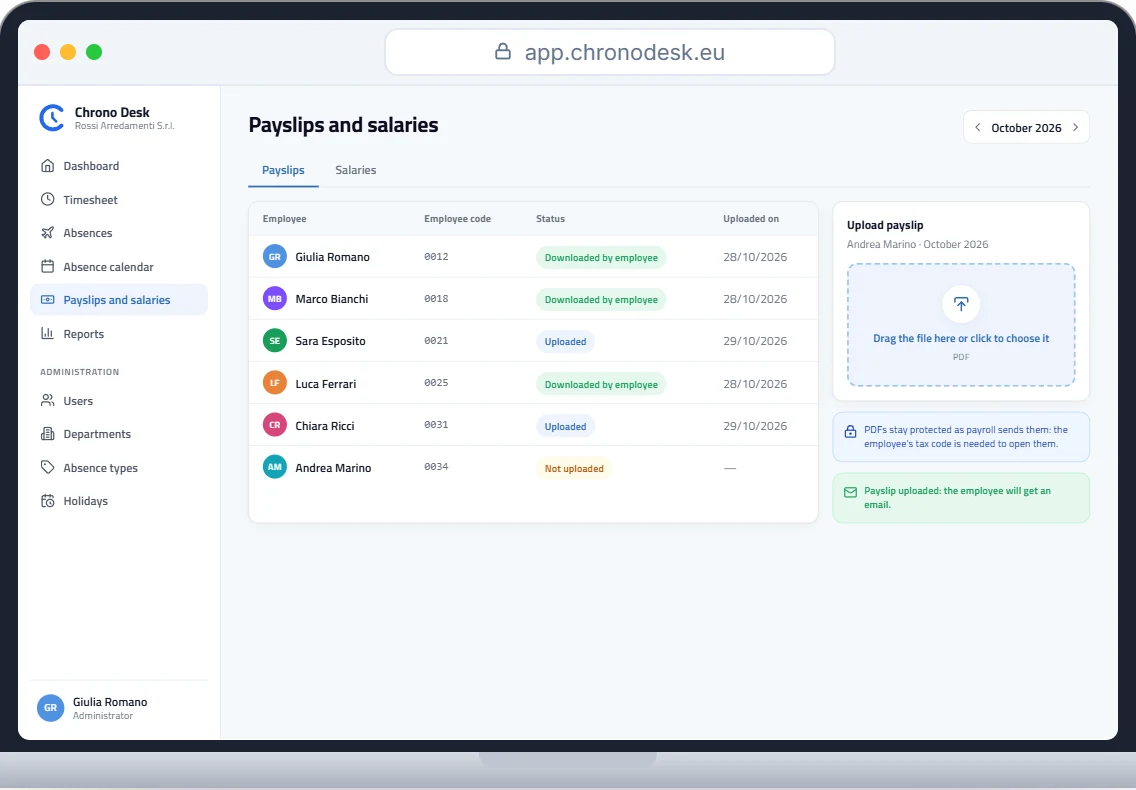
Chrono Desk does not decide the calculation base: that stays with the CCNL and the payroll consultant. It does collect the data to start from: hours worked, days and absences by period and employee, with CSV export (one file per employee in a single ZIP) ready for your consultant. The consultant prepares the payslips and uploads them to Chrono Desk.
To see it with your company’s data, request a demo.
This guide is for information only and does not replace advice from your payroll consultant or the rules of the applicable collective agreement.