ROL and ex-holiday leave in Italy: how it accrues and how unused hours are paid
What ROL and ex-holiday leave are in Italy, who sets the hours, how they accrue and what happens to unused hours: expiry, payout and a worked example.
Published 4 min read
Italian payslips often show two items that are not vacation: ROL (Riduzione Orario di Lavoro, reduction of working hours) and ex festività (ex-holiday leave). Both are paid leave in hours, and the most common question is: “what happens to the hours I don’t use?” Here is who sets them and how they are paid.
What they are and where they come from
No law fixes a number of ROL or ex-holiday hours: the collective agreement (CCNL) does.
- ROL: leave hours that come from working-time reductions negotiated in collective agreements. The law sets normal working time at 40 hours a week but lets collective agreements set a shorter duration (Legislative Decree 66/2003, art. 3). CCNLs often do this by granting leave hours.
- Ex-holidays: Law 54/1977, art. 1, ended the civil holiday status of Epiphany, St Joseph, Ascension, Corpus Domini and Saints Peter and Paul, and moved 2 June and 4 November to the Sunday. Epiphany then became a holiday again (Presidential Decree 792/1985), as did 2 June from 2001 (Law 336/2000), while Saints Peter and Paul stayed a holiday in Rome only. In exchange for the four abolished religious holidays, collective agreements granted individual paid leave.
How many hours: the CCNL decides
Two examples taken from the agreements’ own text:
- Commerce, distribution and services (Confcommercio), art. 161: for the four abolished holidays, groups of 4 or 8 hours of leave. On top, further paid leave: 56 hours a year in companies of up to 15 employees, 72 in companies with more than 15. For people hired after 1 March 2011, the further hours count at 50% after two years and 100% after four.
- Engineering industry (Federmeccanica-Assistal), text of 26 November 2016, art. 5: 13 paid annual leave days of 8 hours, i.e. 104 hours, of which 72 for working-time reduction and 32 in place of the abolished holidays.
Your CCNL may differ, and renewals change the numbers: check the version in force.
How they accrue
It depends on the agreement, but usually they refer to the year of service and are reduced pro rata for people who work only part of the year. In the Commerce CCNL, for example, a twelfth is due for each full month of service. For part-timers the hours follow the reduced schedule, which is why tracking them in hours helps.
ROL, vacation and other leave
- Vacation: a legal minimum of four weeks (Legislative Decree 66/2003, art. 10), which cannot be replaced by money while employment continues. See Vacation and leave in Italy.
- ROL and ex-holidays: they come from the agreement, are counted in hours, and the agreement sets expiry and payout.
- Other leave: granted by law under specific conditions, such as three days a year for bereavement or serious illness (Law 53/2000, art. 4) and three days a month under Law 104 (art. 33, par. 3). Record these separately.
If they are not used
The rule is again in the CCNL, and the hours are usually not lost:
- Commerce: hours not taken in the year they accrue lapse and are paid at the actual pay in force at that date, or can be taken by 30 June of the following year.
- Engineering: unused hours move into an individual hours account for a further 24 months; hours still banked after that are paid at the pay then in force.
When employment ends, hours accrued and not taken are normally settled in the final payslip, under the applicable CCNL’s rules: confirm the specific case with your payroll consultant.
Example: paying out unused ROL
A full-timer on 40 hours, in a commerce company, with actual monthly pay of €1,848. The Commerce CCNL uses an hourly divisor of 168 for a 40-hour week (art. 215). Hours left: 24 ROL and 8 ex-holiday.
| Step | Calculation | Result |
|---|---|---|
| Hourly rate | €1,848 ÷ 168 | €11.00 |
| Hours to pay | 24 + 8 | 32 hours |
| Gross amount | 32 × €11.00 | €352.00 |
This is a gross, indicative figure: the consultant applies the items the agreement requires. To work out an hourly rate with your CCNL’s divisor, use the hourly rate calculator.
Mistakes to avoid
- Assuming a number of hours. There is no value that fits everyone: start from the CCNL.
- Mixing vacation and leave. They have different rules on expiry and payout.
- Ignoring deadlines. Check by when the hours must be taken.
- Recording hours outside the timesheet. The single employment register (LUL) lists hours, overtime and absences day by day, with unambiguous codes (Decree-Law 112/2008, art. 39).
How Chrono Desk does it
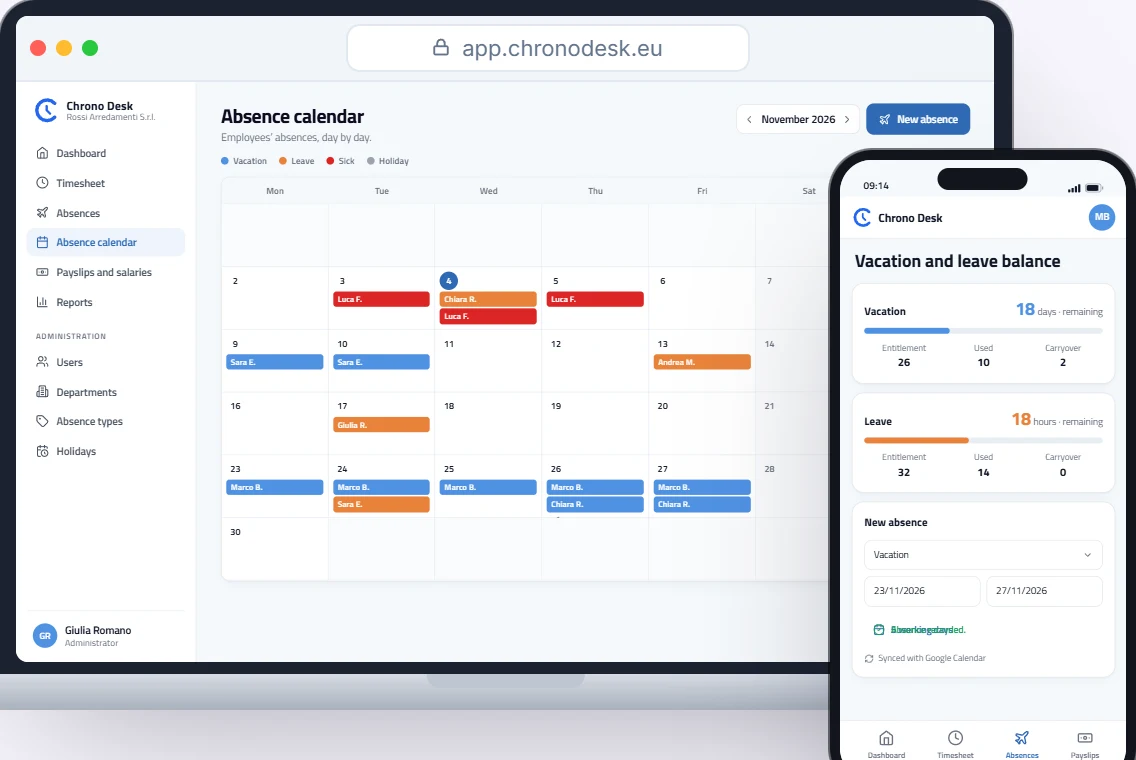
In Chrono Desk you can create your own absence types, such as ROL and ex-holiday leave, tracked in days or hours. For each one every employee sees entitlement, used, remaining and carryover from last year. Absences appear in the team calendar, and the payroll consultant sees the whole company’s.
Want to see how it fits your collective agreement? Talk to us.
This guide is for information only and does not replace advice from your payroll consultant or the rules of your collective agreement.