Resignation and notice period in Italy: online form, long absences and the last month of work
Online resignation revocable within 7 days, notice set by the CCNL, unjustified absence over 15 days and the last-month checklist: leave, TFR, UniLav.
Published 6 min read
When an employee leaves there are the form of the resignation, the notice period, the case of someone who simply stops showing up and a list of things to close in the last month. Since 2025 there is also a rule that matters to anyone keeping attendance records: a prolonged unjustified absence can count as a resignation. Here is the picture.
Resignations are submitted online
Under article 26 of Legislative Decree 151/2015, resignations and mutual terminations are valid only if made, “on pain of ineffectiveness” (a pena di inefficacia), electronically, on the forms of the Ministry of Labour (lavoro.gov.it), sent to the employer and to the local labour office. A letter or an email is not enough.
- How: the employee logs in with SPID or CIE (the Italian digital identity credentials), or gets help from a patronato (trade-union advice office), a union, a payroll consultant, the Labour Inspectorate, a bilateral body or a certification commission (par. 4).
- Revocation: within seven days of the date the form was sent the employee can revoke it, in the same way (par. 2). Until they have passed, do not treat the case as closed.
- Excluded: domestic work, resignations made in a “protected venue” (art. 2113, par. 4, Civil Code) or before certification commissions, and public-sector employment (pars. 7 and 8-bis). During pregnancy and in the first three years of the child’s life (or of placement of the child), resignations and mutual terminations must instead be validated by the Inspectorate (art. 55, par. 4, Legislative Decree 151/2001).
- Probation: a 2016 guide from the Ministry of Labour also excludes withdrawal during probation from the procedure. Check the specific case with your consultant: see probation period.
The notice period
Article 2118 of the Civil Code lets either party withdraw from a permanent contract by giving notice (preavviso). It leaves terms and manner to collective rules, custom or fairness: in practice the CCNL (national collective agreement) sets them, which is why there is no single length that fits everyone. Read the clause in the agreement you apply.
- Without notice: whoever withdraws owes the other party an indemnity equal to the pay for the missing notice period (art. 2118, par. 2). The same indemnity is owed by the employer if the employment ends because the employee dies (par. 3).
- Just cause: article 2119 allows withdrawal without notice if something happens that does not allow the employment to continue, even temporarily (giusta causa). If it is the employee who withdraws for just cause, they are owed the indemnity in lieu of notice. Just cause has to be proven: assess it with your consultant.
- Pregnancy and the child’s first year: someone who resigns during the dismissal-ban period of art. 54 does not have to give notice (Legislative Decree 151/2001, art. 55, par. 1).
If the employee stops showing up
Paragraph 7-bis of art. 26, added by article 19 of Law 203/2024, covers so-called resignation by conduct (dimissioni per fatti concludenti). If the unjustified absence lasts beyond the period set by the CCNL or, failing that, more than fifteen days, the employer may report it to the local office of the National Labour Inspectorate (INL), which may check the report. The employment is then deemed ended by the employee’s own will.
Some clarifications from the Ministry (circular 6/2025) and the INL (note of 22 January 2025):
- It is not automatic. The effect arises only if the employer chooses to rely on the absence.
- Calendar days, unless the CCNL provides otherwise (the Ministry says they “may be understood” that way). If the CCNL sets a longer period, that applies; if shorter, the legal period applies. Some CCNLs attach a disciplinary dismissal to a prolonged absence: in that case follow the procedure of art. 7 of the Workers’ Statute.
- The report should be made, preferably by certified email (PEC), with all the contact details known for the employee, and a copy sent to them too. The INL has published a template.
- The effects run from the date shown in the UniLav, which cannot be earlier than the report to the INL. For the absence period no pay or contributions are due. The employer may withhold from the final pay the indemnity for missing notice set by the agreement.
- Proof to the contrary is on the employee: they must show they could not communicate the reasons for the absence, because of force majeure or the employer’s fault, for example a hospital stay. A resignation for just cause filed online prevails over the employer’s procedure.
- It does not apply in the cases of art. 55 of Legislative Decree 151/2001 (pregnancy and the child’s first three years).
The employer may be liable, even criminally, for untrue reports: what counts is the data on since when the person has been missing, what was done to reach them and which absences were justified (for example sick leave).
Leave, ROL, 13th month and TFR at the end
- Vacation: the four minimum weeks cannot be paid out while the employment continues, “except on termination of the employment” (Legislative Decree 66/2003, art. 10, par. 2). At the end, vacation accrued and not taken is paid as an indemnity in lieu. See unused vacation and the unused vacation pay calculator.
- ROL and ex-holiday leave: remaining hours are normally settled in the final payslip, under the CCNL’s rules: see ROL and ex-holiday leave.
- 13th and 14th month: as many twelfths are paid as there are months accrued, in the final payslip: see 13th and 14th month pay.
- TFR (trattamento di fine rapporto, end-of-service pay): due “in every case of termination of employment” (art. 2120 Civil Code). Payment timing is set by the CCNL: see TFR and the TFR calculator.
Last-month checklist
- The form. Check you received the online resignation, the effective date and that the seven-day revocation window has passed.
- The notice. Ask your consultant what length the CCNL sets and how to handle the indemnity if notice is not served.
- Attendance and balances. Close the timesheet and check remaining vacation, ROL and ex-holiday leave.
- The final payslip. The month’s pay, accruals, unused vacation and TFR, on the CCNL’s timing.
- The UniLav termination notice. It is due within five days of the termination date (indications from the Ministry of Labour and INPS). The consultant usually sends it: confirm that.
- The certificate of employment. On termination, for any reason, the employer must issue a certificate stating the period of employment and the duties performed (art. 2124 Civil Code).
Example: the indemnity for missing notice
An indicative calculation with made-up numbers: gross monthly pay of 1,800 euro, a hypothetical notice of one month. It is not the length in your CCNL.
| Case | Missing notice | Gross indemnity |
|---|---|---|
| Notice served in full | 0 | 0 € |
| Half missing (about 15 days) | 15 days | 900 € |
| Leaves at once | 1 month | 1,800 € |
Items included and deductions depend on the CCNL and are calculated by the consultant.
Mistakes to avoid
- Accepting a letter or an email as a resignation: without the online form it is not effective.
- Assuming the notice length. Start from the CCNL.
- Reporting an absence to the INL too early, or with no trace of what was done to reach the employee.
- Forgetting the UniLav termination notice or its five days.
How Chrono Desk does it
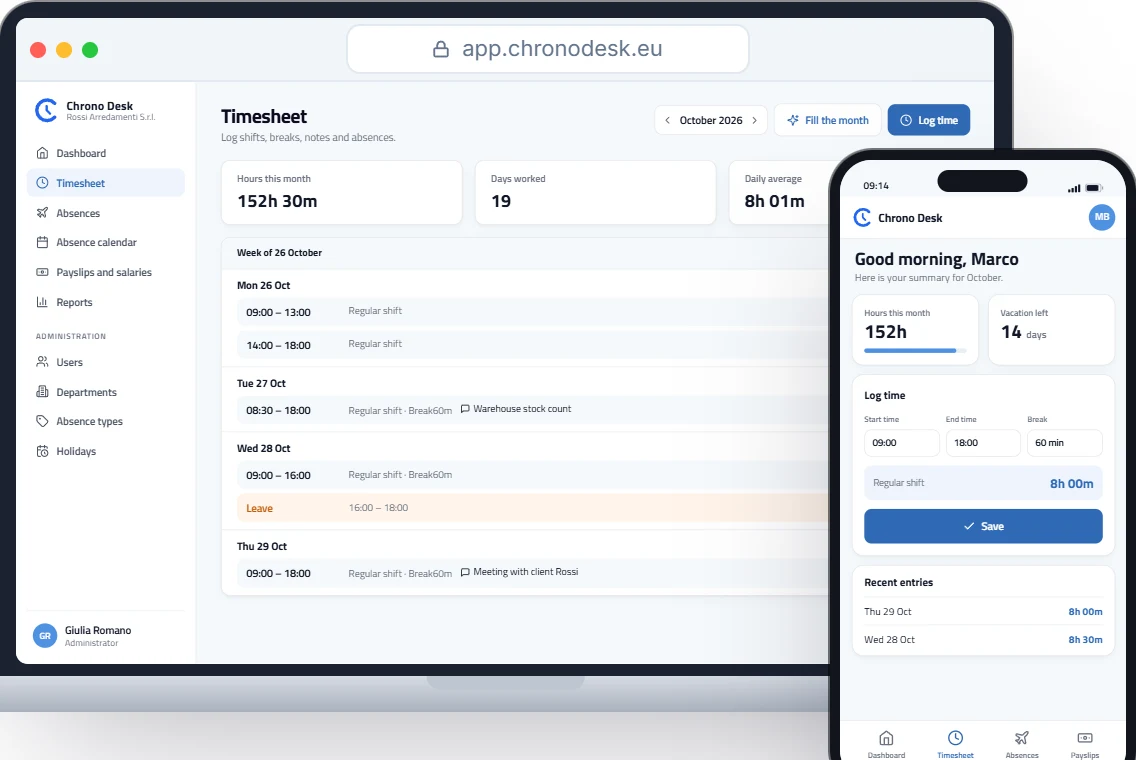
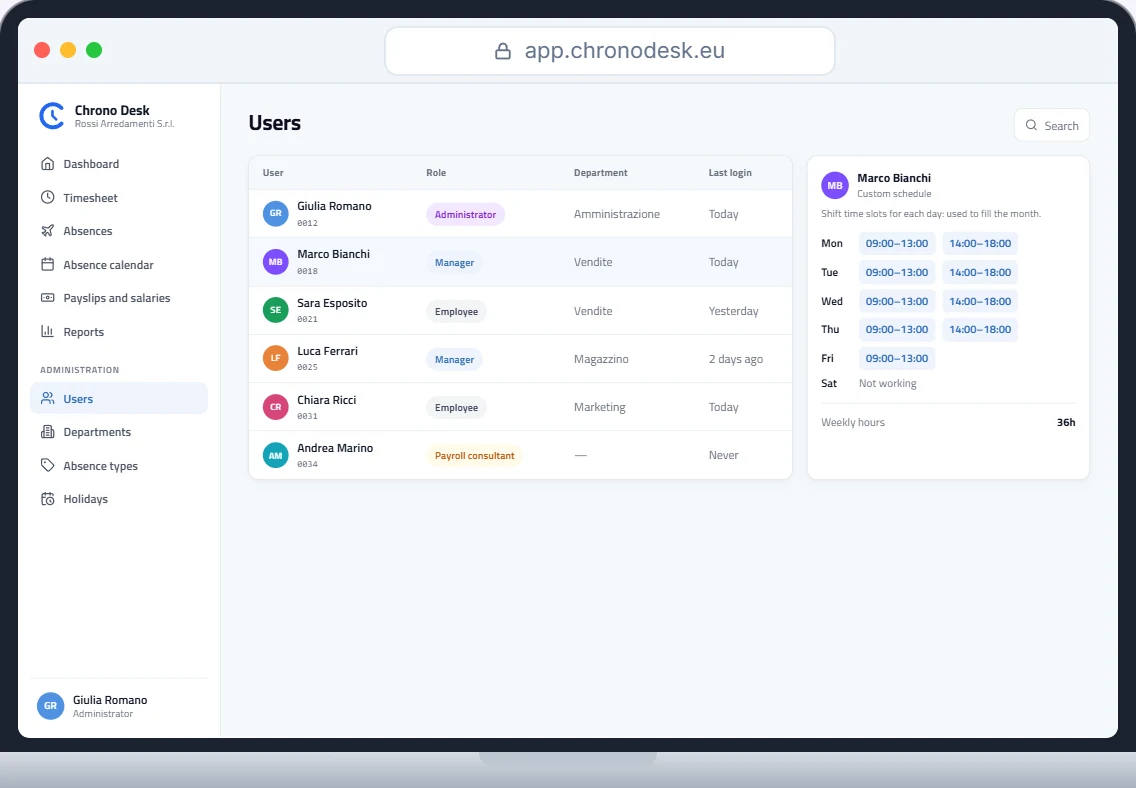
Chrono Desk does not handle resignations, which go through the Ministry’s portal, nor the UniLav, which stays with your consultant. It does give you the data you need. In the timesheet you find the hours, absences and notes for each day, and the report shows days and absences by period, with CSV export for the consultant. In vacation and leave each employee sees entitlement, used and remaining: when someone leaves, the balances are ready for the final payslip. For the start of employment see the new-employee checklist.
Want to see how it fits your collective agreement? Talk to us.
This guide is for information only and does not replace advice from your payroll consultant or the rules of your collective agreement.