Daily rest, weekly rest and breaks in Italy: the rules for schedules and shifts
Italy's 11-hour daily rest, 24-hour weekly rest and break after 6 hours: what Legislative Decree 66/2003 says, derogations and close-then-open shifts.
Published 4 min read
When planning schedules, most people look at how many hours are worked. But Italian law also sets how much people must rest: between one day and the next, every week, and during the day. These rules are easily broken by close-then-open shifts. Here is what the law says and how to keep track of it.
The three basic rules
The rules are in Legislative Decree 66/2003, arts. 7, 8 and 9.
- Daily rest (art. 7): the employee is entitled to 11 consecutive hours of rest every 24 hours. The rest must be taken consecutively, except for work that is split into several periods during the day.
- Break (art. 8): if the daily working time exceeds 6 hours, the employee must get a break, whose terms and length are set by collective agreements.
- Weekly rest (art. 9): at least 24 consecutive hours every 7 days, normally on Sunday, added to the daily rest hours. It may be calculated as an average over a period of no more than 14 days.
The break: what the CCNL decides
For the break, the law refers to the collective agreement (CCNL, contratto collettivo nazionale di lavoro). Only if the CCNL provides no break at all is the employee still entitled to a break of at least 10 minutes, which may be taken at the workplace and scheduled with the technical needs of the work in mind (art. 8, par. 2).
Length, timing and whether the break is paid or counts as working time therefore depend on the agreement: check your CCNL and don’t assume another sector’s rule applies.
Daily rest: the close-then-open example
The most common case is an employee who closes in the evening and opens the next morning.
| Step | Time |
|---|---|
| Tuesday: end of closing shift | 23:30 |
| Earliest possible restart (23:30 + 11 hours) | Wednesday 10:30 |
| Wednesday: opening shift as planned | 08:00 |
| Actual rest | 8 hours 30 minutes |
| Hours short of the 11 | 2 hours 30 minutes |
An 08:00 opening is not compatible with a 23:30 close unless a derogation applies: either start at 10:30 or change who opens.
Weekly rest
The 24 consecutive hours of weekly rest are added to the 11 hours of daily rest, so in practice about 35 consecutive hours without work are needed. The rest normally falls on Sunday, but many activities can set it on another day. Art. 9, par. 3, lists for example seasonal, continuous-process and public-utility work.
When a derogation is possible
Not every rule applies in the same way everywhere.
- Art. 17, par. 1: arts. 7 and 8 (daily rest and breaks) can be derogated by national collective agreements with the most representative trade unions. In the private sector, if the national agreement is silent, territorial or company agreements can do so.
- Art. 9, par. 2: weekly rest has its own exceptions, for example for shift work when the employee changes shift or team and cannot take the rest between the end of one shift and the start of the next, and for work split over the day. Collective agreements may set different rules.
- Compensation (art. 17, par. 4): a derogation is allowed on condition that the employee is given equivalent compensatory rest or, in exceptional cases where that is objectively impossible, appropriate protection.
- Unmeasured working time: for people whose working time is not measured or predetermined, such as managers, some rules do not apply (art. 17, par. 5): check each case with your payroll consultant.
A derogation is therefore never “free”: the rest that is skipped must be made up, and the make-up must be documented.
How to record it in the timesheet
- For each day note start, end and break: without real times, rest cannot be checked.
- Compare the end of the previous day with the start of the next: the gap must be at least 11 hours, unless a derogation applies.
- Mark the weekly rest day and, if you use a derogation, the compensatory rest granted.
- Keep compensatory rest hours separate from vacation and leave.
For the general set-up read the guide to employee timesheets, for shifts the one on shift planning, and for hours beyond normal time the one on overtime.
Mistakes to avoid
- Checking only hours worked and not the gap between the end of one shift and the start of the next.
- Scheduling a close followed by an open without checking the 11 hours.
- Assuming the break is the same for everyone: length and pay are set by the CCNL.
- Using a derogation with no compensatory rest: the derogation requires it.
- Estimating times at month end instead of recording real ones: rest can’t be reconstructed from memory.
How Chrono Desk does it
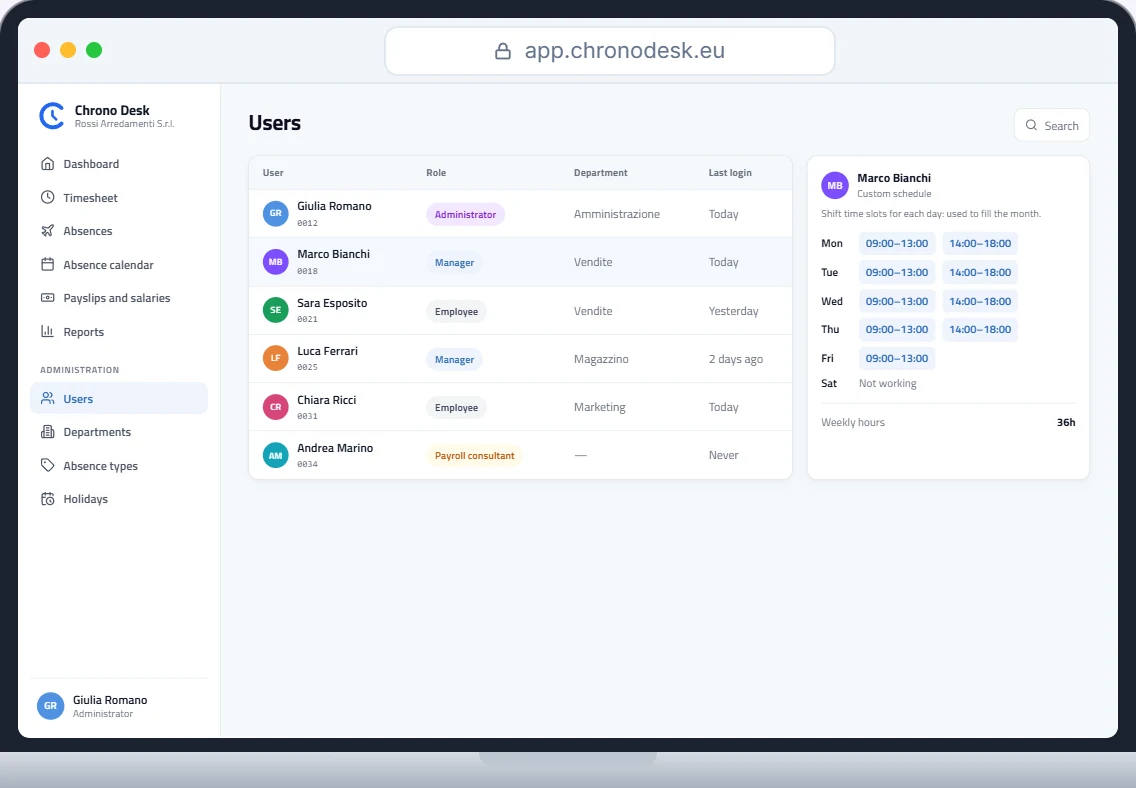
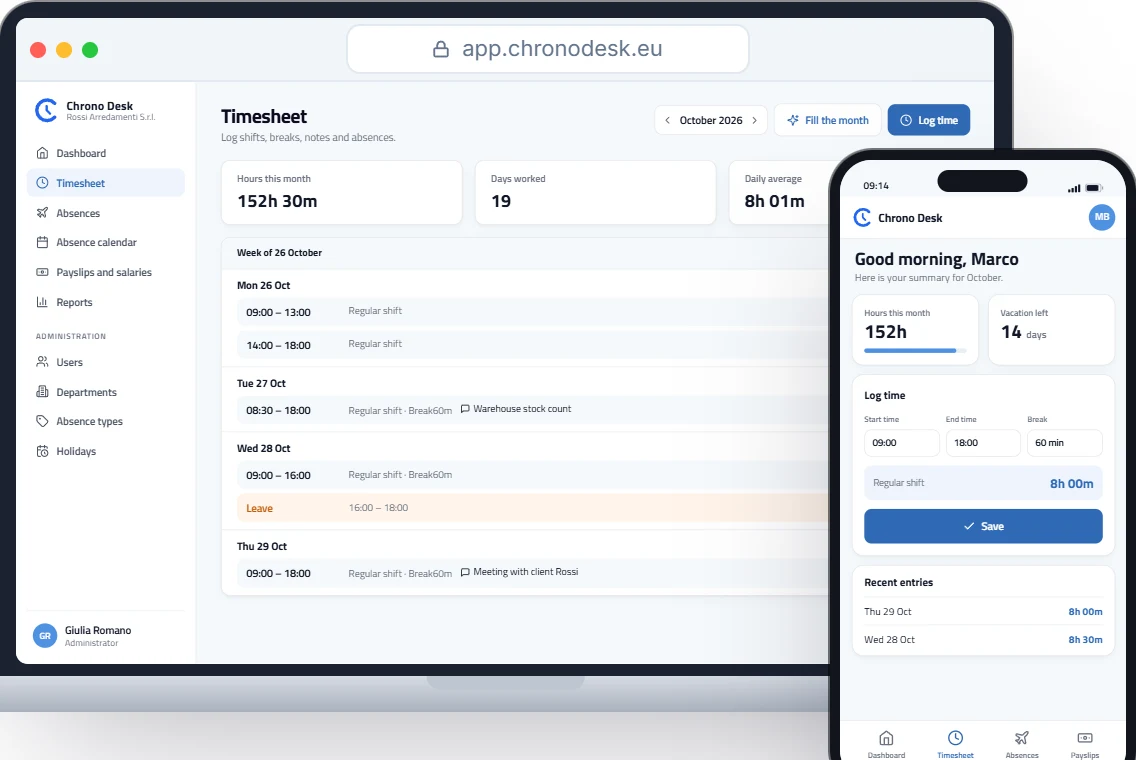
In Chrono Desk each employee records the start and end of the day with the break, or just the total hours, and hours are calculated automatically. With real times day by day, seeing how long passes between the end of one shift and the start of the next becomes an instant check. Custom schedules also allow several time slots in the same day, useful for split shifts, and the manager sees the team’s timesheets.
Want to see how it works with your company’s shifts? Talk to us.
This guide is for information only and does not replace advice from your payroll consultant or the rules of your collective agreement.