Fixed-term contracts in Italy: duration, reasons, extensions, renewals and limits
Fixed-term contracts in Italy: 12 months without a reason, up to 24 with one, extensions, renewals, the 20% cap, right of first refusal and dates to track.
Published 5 min read
A fixed-term contract (contratto a tempo determinato) is easy to sign and easy to get wrong: one extension too many, or one day over the limit, and the job becomes permanent. The rules are in Legislative Decree 81/2015 (arts. 19-29), amended several times in recent years. Here are duration, reasons, extensions, limits and what to keep under control.
Form and duration
- Written form. The fixed term must be in writing and a copy given to the worker within five working days of starting. It is not required for contracts of up to twelve days (art. 19, par. 4).
- Up to 12 months: no reason needed. Beyond that, the contract is lawful only if a condition in art. 19, par. 1 applies; otherwise it becomes permanent from the day the limit is passed (par. 1-bis).
- Up to 24 months: with a reason (causale). The conditions are: a) cases set by collective agreements (art. 51); b) where there are none, and in any event by 31 December 2026, technical, organisational or production needs identified by the parties; c) replacing other workers. The date in letter b) has been moved several times: check the text in force. Write the reason concretely, not in generic wording.
- 24-month ceiling. It applies to the sum of fixed-term contracts between the same employer and worker, for duties of the same level and legal category, including agency assignments and regardless of gaps (par. 2). Beyond it, the job becomes permanent. One further contract of up to 12 months is possible only if signed at the territorial labour inspectorate (par. 3).
The 12-month count only includes contracts signed since the Decreto lavoro came into force (Decree-Law 48/2023, art. 24, par. 1-ter). The collective agreement (CCNL) may set different rules: start from the text in force.
Extensions, renewals and gaps
- Extension (proroga, lengthening the same contract): it needs the worker’s consent and is allowed only if the initial term is under 24 months. At most four extensions in 24 months: from the fifth the contract becomes permanent (art. 21, par. 1).
- Renewal (rinnovo, a new contract): in the first twelve months extensions and renewals are free; after that a reason under art. 19, par. 1 is needed, or the contract converts (art. 21, par. 01).
- Gaps. A new contract within 10 days of one lasting up to six months, or within 20 days of a longer one, becomes permanent, except for seasonal activities and cases set by collective agreements (art. 21, par. 2).
Cap on the number of fixed-term workers
Unless the CCNL says otherwise, fixed-term workers cannot exceed 20% of permanent employees on 1 January of the hiring year, rounding up from fractions of 0.5. Employers with up to five employees can always hire fixed-term. Exempt, among others, are replacements, seasonal activities and workers over 50 (art. 23, pars. 1-2). Going over the cap does not convert contracts but triggers a fine per worker: 20% of pay for each month or part over 15 days, 50% if more than one worker is involved (par. 4).
Right of first refusal
Someone who worked fixed-term for the same employer for more than six months has, unless the CCNL says otherwise, priority (diritto di precedenza) in permanent hiring for the same duties over the following twelve months. It must be mentioned in the written contract and the worker must claim it in writing within six months of the end of employment; it lapses after one year (art. 24, pars. 1 and 4).
Cost, vacation, 13th month and TFR
- Surcharge: 1.4% of taxable pay, with +0.5 points at each renewal; it is not due, for example, for replacements (Law 92/2012, art. 2, pars. 28-29). According to INPS (circular 121/2019) the increase does not apply to extensions.
- Equal treatment: same pay and conditions as comparable permanent staff, in proportion to the period worked (art. 25).
- Vacation and 13th month accrue month by month, in twelfths: see vacation and leave and 13th and 14th month pay.
- TFR (severance pay): the yearly share is reduced for part-years (Civil Code art. 2120) and paid at the end of the contract: see TFR. For probation, proportional to duration, see the probation period guide.
Example: the dates of one contract
Invented dates: a 6-month contract, then one extension with the worker’s consent.
| Date | Event | What to check |
|---|---|---|
| 1 Mar 2026 | Start, 6 months | written contract, copy within 5 working days |
| 31 Aug 2026 | Initial expiry | extension with consent: the first of 4 at most |
| 28 Feb 2027 | End, 12 months in all | beyond this, a reason is needed |
| 1-20 Mar 2027 | Gap | a new contract here becomes permanent |
| 28 Aug 2027 | Six months after the end | deadline for the written priority claim |
The contract lasted more than six months in total, so the right of first refusal applies.
Mistakes to avoid
- Extending without consent, or beyond the fourth extension.
- Passing 12 months without a reason, or writing it generically.
- Renewing after a few days without respecting the gap.
- Losing count of months across several contracts for the same worker.
- Forgetting the 20% cap.
How Chrono Desk does it
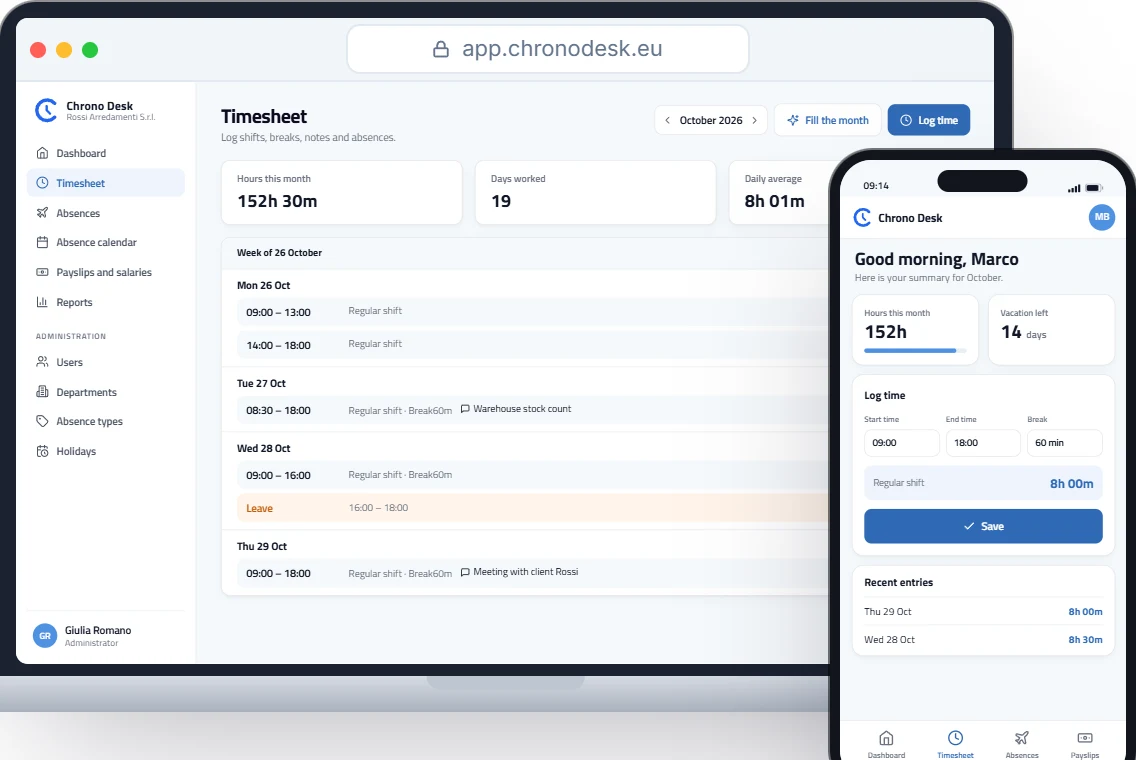
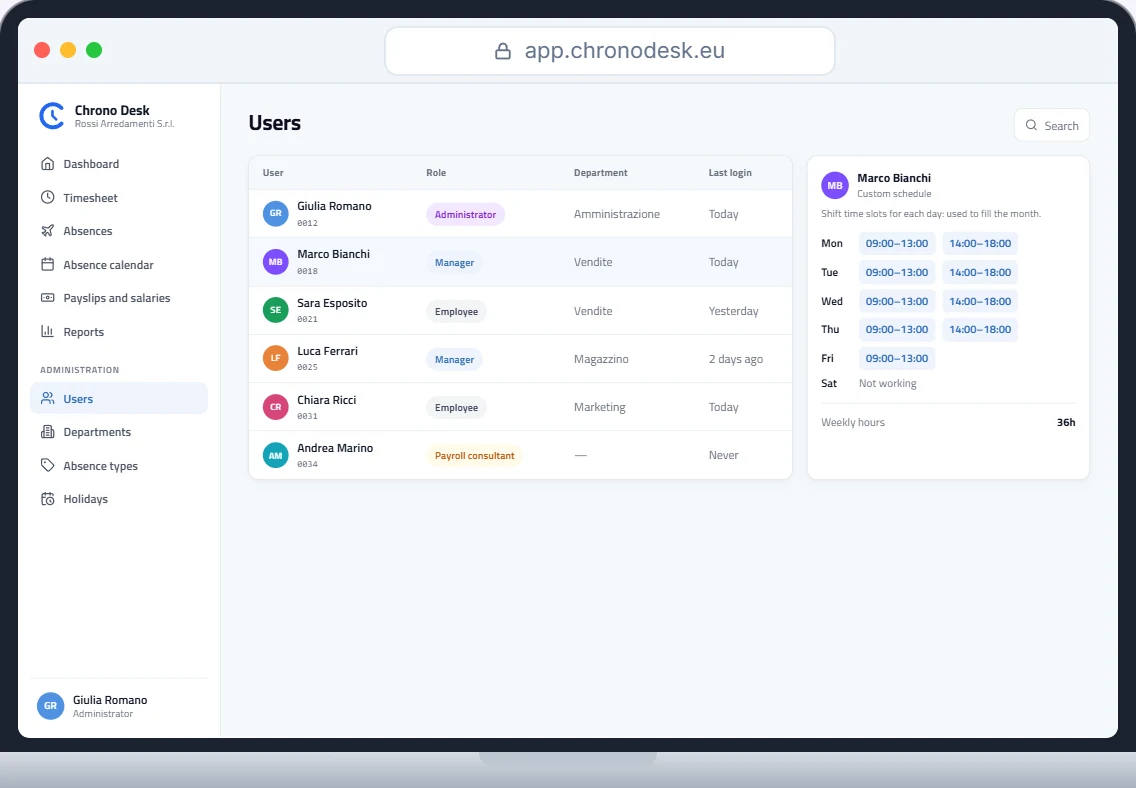
Chrono Desk does not manage the employment contract, which stays with your consultant. For each employee you set contract and schedule; vacation and leave accrue in vacation and leave, also in hours, and the timesheet shows how much they worked. Deadlines, however, go in your HR calendar: start and end, number of extensions, the 12-month threshold and the end of the priority window.
Want to see how it fits your fixed-term contracts? Talk to us.
This guide is for information only and does not replace advice from your payroll consultant or the rules of your collective agreement.