TFR severance pay in Italy: how it is calculated and paid
Italian TFR severance pay made simple: how it accrues each year, how it is revalued, when an advance is possible and how it is taxed.
Published 3 min read
TFR (trattamento di fine rapporto) is the amount an Italian employer sets aside every year and pays the employee when employment ends. It is deferred pay: it accrues month after month but is received at the end. Here is how it is calculated, how it grows over time and when it can be paid early.
How TFR accrues
The rule is in article 2120 of the Italian Civil Code. Every year TFR accrues an amount equal to annual pay divided by 13.5.
Annual pay includes everything paid on a non-occasional basis: salary, 13th month pay, any 14th month and the fixed items set by the collective agreement (CCNL). Expense reimbursements are excluded. The collective agreement can exclude some items from the calculation.
A 0.50% contribution on pay, which the employer pays to INPS, is deducted from the accrual. So the actual accrual is:
Annual accrual = annual pay ÷ 13.5 − 0.50% of annual pay
An example with indicative figures: with annual pay of €28,000, the accrual is 28,000 ÷ 13.5 = €2,074.07, minus a €140 contribution, so about €1,934 a year.
How it is revalued
Accrued TFR does not stand still. Every year, at 31 December, the fund accrued up to the previous year is revalued at a rate of:
- 1.5% fixed, plus
- 75% of the increase in the ISTAT price index compared with December of the previous year.
With 2% inflation, for example, the revaluation is 1.5% + 1.5% = 3%. The amount accrued during the current year is not revalued until the following year. The revaluation is subject to a substitute tax, withheld at source.
To estimate TFR with your own figures, use our free TFR severance pay calculator.
Where TFR goes
The employee can choose to:
- leave it with the employer: in companies with fewer than 50 employees the employer keeps it; in companies with 50 or more it goes to the INPS Treasury Fund, which manages it on the employee’s behalf;
- pay it into a supplementary pension fund, which invests it for retirement.
When it is paid
TFR is paid when employment ends, for any reason: resignation, dismissal, end of a fixed-term contract or retirement. The collective agreement sets the payment timing.
Before employment ends, an employee can ask for an advance under these conditions (Civil Code, art. 2120):
- at least 8 years of service with the same employer;
- an advance of up to 70% of the TFR accrued;
- a reason allowed by law, such as major medical costs or buying a first home for themselves or their children.
The advance can be requested only once during employment, and each year the employer has to grant only a limited number of requests. Collective and company agreements can set more favourable terms.
How it is taxed
TFR is not added to the year’s other income: it is taxed separately. An average rate based on the income of previous years applies, and the Revenue Agency can later recalculate the tax. That is why net TFR is usually higher than it would be if taxed like a salary.
How Chrono Desk does it
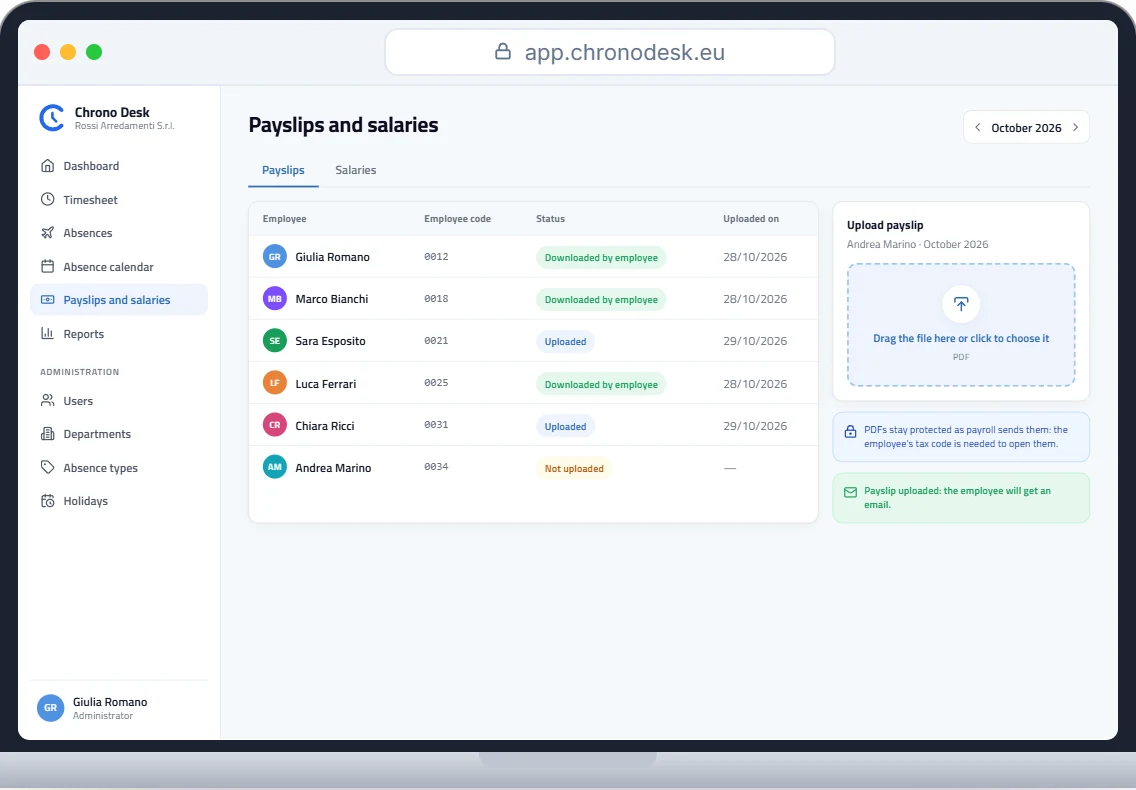
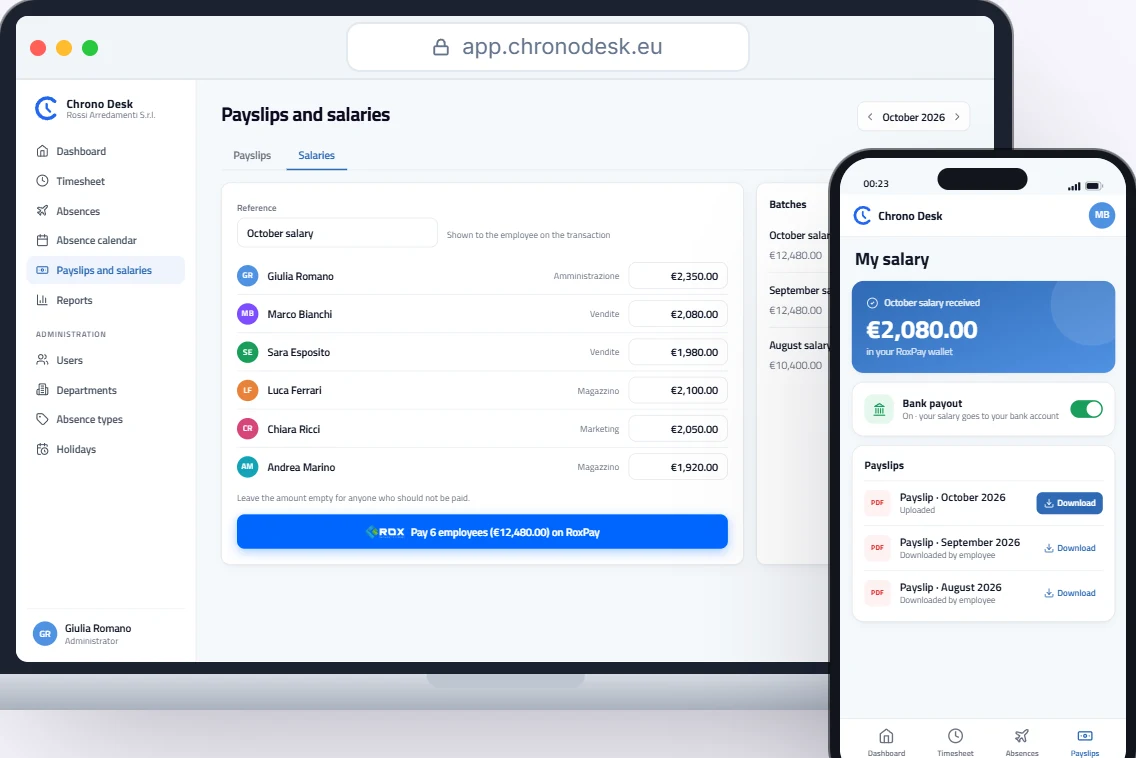
TFR is calculated on the payslip by your payroll consultant. With Chrono Desk, the consultant uploads PDF payslips and every employee finds them in their own area, with salaries paid from the RoxPay account and linked to each payslip. So accruals, TFR and payments are always traceable.
To see it with your company’s data, request a demo.
This guide is for information only and does not replace advice from your payroll consultant or the rules of the applicable collective agreement.