Probation period in Italy: maximum length, withdrawal and what happens during absences
How the probation period works in Italy: written agreement, maximum length, fixed-term contracts, withdrawal, sickness and maternity, and how to track it.
Published 5 min read
The probation period (periodo di prova) is a short but delicate phase: both sides can still pull out under much lighter rules than usual. That is exactly why the rules must be followed to the letter, starting with the form. Here is what the law says, what it leaves to the collective agreement and how to keep track of it.
The probation agreement must be in writing
Under article 2096 of the Civil Code, hiring for a probation period must be shown by a written document. Both parties must allow and carry out the trial that is the subject of the agreement. So it pays to state in the contract the length and the duties the trial covers: case law is strict about generic clauses, so have your payroll consultant check the wording.
The employer must also tell the employee the length of the probation, if there is one (Legislative Decree 152/1997, art. 1, par. 1, letter h), by handing over the written contract or a copy of the hiring notice before work starts (par. 2).
How long it can last
- General rule: probation cannot exceed six months, unless collective agreements set a shorter length (Legislative Decree 104/2022, art. 7, par. 1). Six months is a ceiling: the collective agreement (CCNL) can only shorten it.
- Office staff: Royal Decree-Law 1825/1924 (art. 4) sets tighter limits for impiegati (white-collar employees): six months for agents with power of attorney (procuratori), directors and equivalent roles, three months for other office staff. The actual length, level by level, is set by the CCNL: check the text in force.
- Law 604/1966, art. 10: the dismissal rules apply to people hired on probation from the moment the hiring becomes definitive, and in any case after six months from the start of the employment.
Fixed-term contracts: proportional probation
For fixed-term work the probation is proportional to the contract length and the duties (art. 7, par. 2). For contracts starting from 12 January 2025, unless the CCNL is more favourable, probation is one day of actual work for every fifteen calendar days, with a minimum of two days and a maximum of fifteen (contracts up to six months) or thirty (over six and under twelve months). The Ministry of Labour (circular 6/2025) states that the maximums cannot be departed from even by a CCNL, and that for contracts over twelve months the same calculation applies, even beyond thirty days. If the contract is renewed for the same duties, a new probation cannot be imposed.
Withdrawal during probation
During probation either party may withdraw without notice or severance; however, if the probation is set for a necessary minimum time, withdrawal cannot happen before it ends (art. 2096, par. 3). Withdrawal stays free: the Constitutional Court (ruling 189/1980) ruled out a general duty to give reasons. One limit: the ban on dismissing women from the start of pregnancy until the child is one year old does not apply when the probation fails, but the ban on discrimination still stands (Legislative Decree 151/2001, art. 54, par. 3, letter d).
Someone who leaves during probation does not lose what has accrued: the same ruling recognised paid vacation and the seniority indemnity, later replaced by the TFR (trattamento di fine rapporto, end-of-service pay). If the CCNL sets different rules, for example on the terms of withdrawal, those apply: read the clause.
Vacation, sickness and other absences
If illness, injury or compulsory maternity or paternity leave occur during probation, the probation is extended by the length of the absence (Legislative Decree 104/2022, art. 7, par. 3). The Ministry (circular 19/2022) clarifies that the list is only an example and also covers other absences provided by law or by agreement, such as Law 104 leave. As for what a sickness does to the right to withdraw, the CCNL and case law matter: talk to your consultant. Vacation normally accrues with service as for other employees: see vacation and leave, sick leave and maternity and paternity leave.
How to record it
- UniLav. The hiring notice is due by the day before the start (Decree-Law 510/1996, art. 9-bis, par. 2). The payroll consultant usually sends it. If employment ends during probation, ask about the termination notice and its deadline too.
- A clause in the contract, with length and duties, and the information handed to the employee.
- Dates in the HR calendar: start, end and a reminder a few days before.
- Absences logged straight away, because they move the end date.
- A decision before the end date. Once probation is completed the hiring becomes definitive and the service counts toward seniority (art. 2096, par. 4).
Example: probation in fixed-term contracts
An indicative calculation for contracts starting from 12 January 2025, with no more favourable CCNL rule.
| Contract length | Calculation | Probation |
|---|---|---|
| 20 days | 20 ÷ 15 = 1.33 | 2 days (minimum) |
| 90 days | 90 ÷ 15 | 6 days |
| 180 days | 180 ÷ 15 | 12 days (cap 15) |
| 300 days | 300 ÷ 15 | 20 days (cap 30) |
The days are days of actual work, and if the employee falls ill the probation is extended.
Mistakes to avoid
- No written agreement. The law requires writing: have it signed before work starts.
- Duties not stated. A generic clause is at risk.
- Forgetting the end date. After probation the hiring is definitive and the ordinary dismissal rules apply.
- Ignoring absences. Illness, injury and compulsory leave lengthen the probation.
- Applying a ceiling from memory. Length and rules depend on the CCNL: start from the text in force.
How Chrono Desk does it
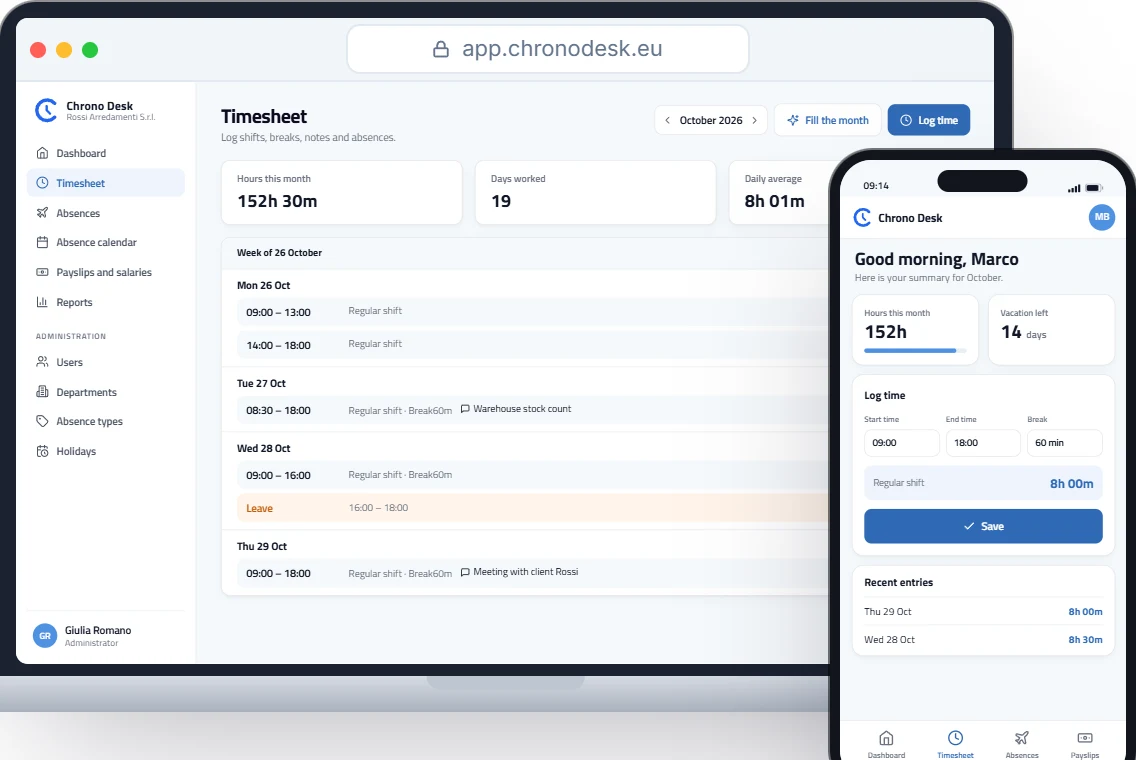
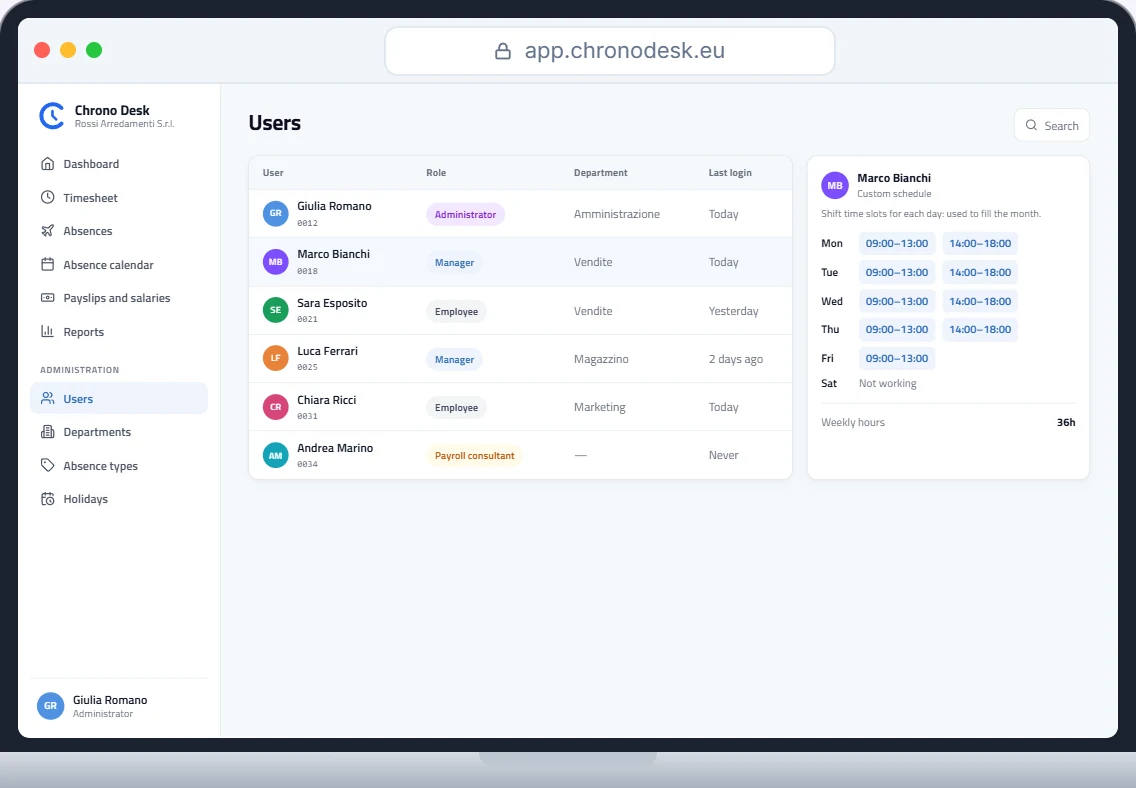
Chrono Desk does not manage the probation agreement, which stays in the contract and with your consultant. It does help you keep track: for each employee you set the contract and schedule, and absences such as sickness are dedicated types in vacation and leave, visible in the team calendar and the timesheet. You can see how many days of absence built up in the period, and the consultant finds them in the reports. The probation end date, however, goes in your calendar: for the rest of onboarding see the new-employee checklist.
Want to see how it fits your collective agreement? Talk to us.
This guide is for information only and does not replace advice from your payroll consultant or the rules of your collective agreement.