Maternity and paternity leave in Italy: what the law says and how to record it
Maternity: five months with INPS pay at 80%. Compulsory paternity: 10 days at 100%. What Italian law says and how employers should record both.
Published 4 min read
When an employee is expecting a child, or is about to become a father, the company needs to know which absences are compulsory by law, who pays for them and how they count towards vacation and the 13th month. This guide covers maternity leave (congedo di maternità) and compulsory paternity leave (congedo di paternità obbligatorio), both governed by Legislative Decree 151/2001. Optional parental leave (congedo parentale) has its own rules and is not covered here.
Maternity leave: the periods
Art. 16 of Legislative Decree 151/2001 bars employers from making employees work:
- in the two months before the presumed date of birth;
- in the period between the presumed and the actual date, if the birth is late;
- in the three months after the birth.
If the birth is early, the days not taken beforehand are added to the leave after the birth, even beyond the overall five months (art. 16, par. 1, letter d).
Flexibility and extensions
- Flexibility (art. 20): with the total length unchanged, the employee may stop work from the month before the birth and for the four months after. This needs a certificate from a National Health Service (or contracted) specialist and from the company doctor (medico competente) that the option does not harm the health of mother and unborn child.
- After the birth only (art. 16, par. 1.1): on the same medical conditions, she may work until the birth and take leave in the five months that follow.
- Early prohibition (art. 17): the local health authority (ASL) may order leave for serious pregnancy complications; the labour inspectorate may do so for harmful working conditions or when the employee cannot be moved to other duties. It is an external order: file it with the dates.
- Prenatal checks (art. 14): tests and medical visits during working hours give a right to paid time off, on request and with documents showing the date and time.
Who pays
For the whole leave the employee receives a daily allowance of 80% of pay (art. 22, par. 1). According to INPS, the employer normally advances it in the payslip; in other cases INPS pays directly. Art. 1, par. 2, preserves more favourable terms in collective agreements: if your CCNL (national collective agreement) tops up the allowance, you will find it there.
How it counts for vacation and the 13th month
Art. 22, par. 3, says maternity leave must count towards length of service for all purposes, including the 13th month (or Christmas bonus) and vacation. So vacation keeps accruing during the leave, but par. 6 bars taking it during the same period.
For TFR (severance pay) the provision is not explicit: confirm with your payroll consultant how to accrue it. For more: Vacation and leave, 13th and 14th month pay, TFR.
Compulsory paternity leave
Art. 27-bis (introduced by Legislative Decree 105/2022) gives the working father:
- 10 working days, 20 for multiple births, which may be non-consecutive but cannot be split into hours;
- from two months before the presumed date of birth to five months after; it also applies if the child dies perinatally;
- written notice to the employer at least five days ahead, where possible; the company’s absence-management system can be enough;
- an allowance of 100% of pay, paid by INPS; where payment is by adjustment (through the employer) the employee does not apply online to INPS.
It is an independent right, which can be used even while the mother is on leave (par. 3). Alternative paternity leave (art. 28) is different: the father takes the mother’s leave if she dies, is seriously ill, abandons the child, or the father has sole custody; the allowance is 80%. Since 24 July 2025, following Constitutional Court ruling 115/2025, the leave is also due to the intended mother in a female couple registered as parents.
For the economic and legal treatment of compulsory paternity leave INPS refers to art. 22, so the rules above on vacation and the 13th month apply here too. Percentages and requirements are set by legislation: always check the INPS pages in force.
Example: 10 days of paternity leave
A full-time father, Monday to Friday, with a mid-week public holiday. He takes the leave in two blocks.
| Period | What happens | Record as |
|---|---|---|
| Monday to Friday, week 1 | Absent 5 days | Paternity leave, days 1-5 |
| Week 2, Wednesday holiday | Absent Monday, Tuesday, Thursday, Friday | Days 6-9, the holiday is not a working day |
| Monday, week 3 | Absent | Day 10 |
Total: 10 working days, with the allowance at 100%.
Mistakes to avoid
- Recording them as vacation, sick leave or generic leave. They are statutory leave with their own allowance.
- Letting vacation overlap with the leave. They cannot coincide (art. 22, par. 6).
- Splitting paternity leave into hours or counting holidays. The days are whole working days.
- Losing dates and documents. Certificates, ASL or inspectorate orders and written notices help the consultant with the adjustment.
How Chrono Desk does it
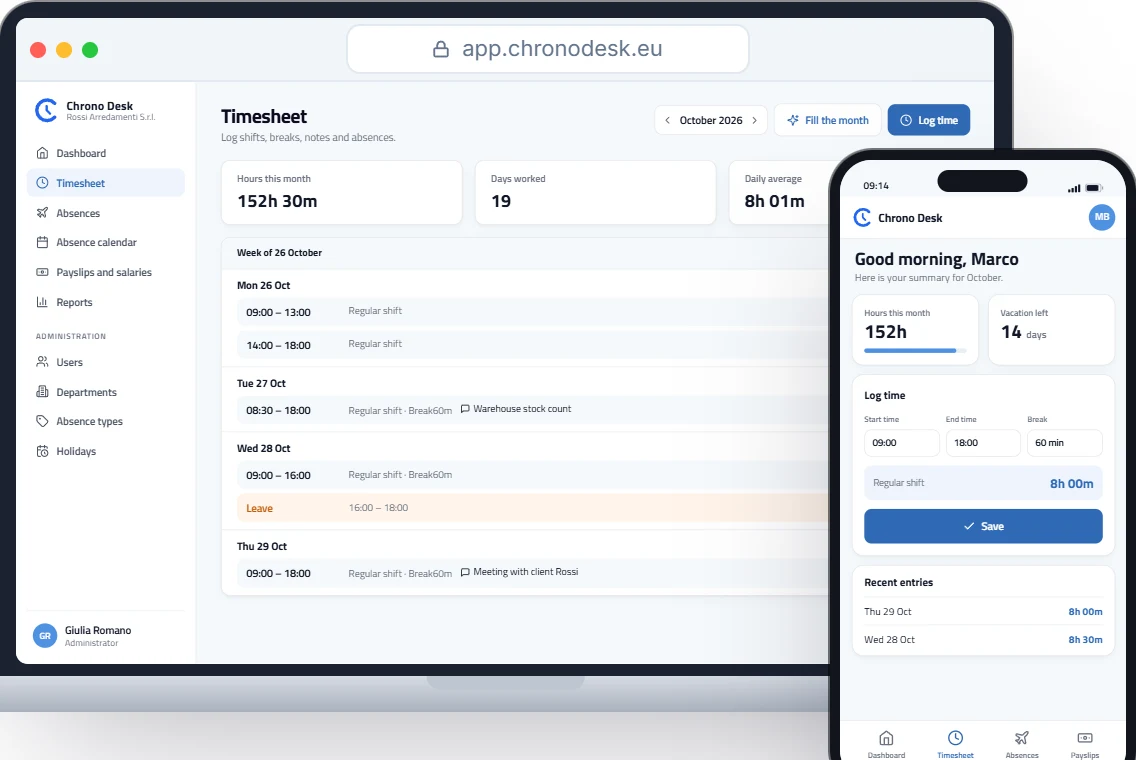
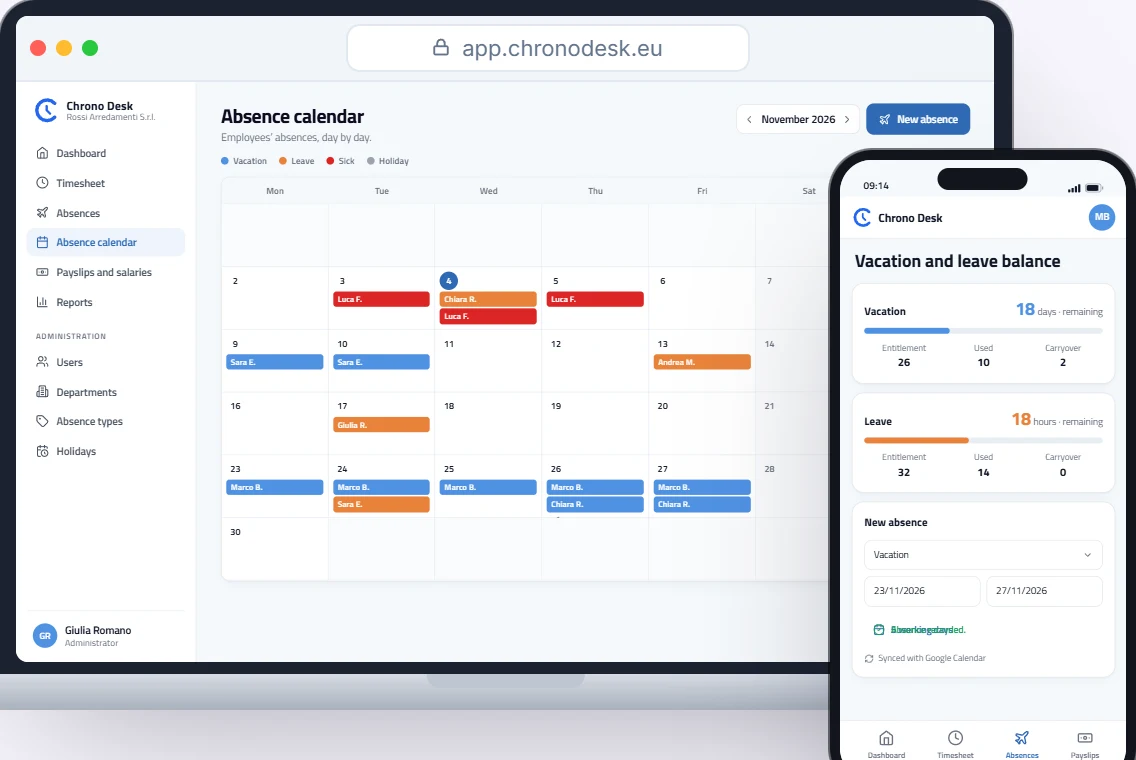
In Chrono Desk you create dedicated absence types for maternity and paternity leave, separate from vacation, ROL and sick leave. The employee sends the request from the app, the days appear in the team calendar and in the timesheet, and in the report the payroll consultant finds the exact dates for the allowance. For other absences see Bereavement and family leave in Italy and Law 104 leave in Italy.
Want to see how it fits your collective agreement? Talk to us.
This guide is for information only and does not replace advice from your payroll consultant or the rules of your collective agreement.