Patron saint days in Italian cities: dates and what they mean for work
Patron saint feast dates in 26 Italian cities, with the weekday in 2026 and 2027, and what they mean for leave, payroll and the collective agreement.
Published 6 min read
Every year, when the calendar is being prepared, the same questions come back: when is Milano’s patron saint day? Is it a day off in Napoli? If I have a site in Torino and one in Bologna, how many local holidays do I have to mark? The dates are easy to find. How that day is treated is not, because the patron saint’s day (santo patrono) is a local holiday and is not part of the national list. Here are the dates for 26 cities, with the weekday in 2026 and 2027, and what to check before adding them to the company calendar.
What the law says
The list of national public holidays is in art. 2 of Law 260/1949, as amended: there are 13 from 2026, including 4 October (St Francis of Assisi, Law 151/2025). The patron saint is not on it. Art. 2 of Law 90/1954 names it among the days that collective agreements may treat as holidays.
This means that, as a rule, it is the CCNL (the collective agreement) and company agreements, not the municipality’s calendar, that decide whether that day is a holiday for your employees and how it is paid. Roma is the exception: 29 June, Saints Peter and Paul, is a holiday by law (Presidential Decree 792/1985, art. 1). For the rules on holidays worked and how they are paid, see our guide to working on public holidays.
The dates in 26 cities
The dates are those of the patron’s feast, checked against municipal and diocesan websites and compared with the list of provincial capitals’ patron saints on Italian Wikipedia. The weekday changes every year, the date does not.
| City | Patron saint | Date | 2026 | 2027 |
|---|---|---|---|---|
| Ancona | St Cyriacus | 4 May | Monday | Tuesday |
| Aosta | St Gratus | 7 September | Monday | Tuesday |
| Bergamo | St Alexander | 26 August | Wednesday | Thursday |
| Bologna | St Petronius | 4 October | Sunday | Monday |
| Brescia | Saints Faustinus and Jovita | 15 February | Sunday | Monday |
| Cagliari | St Saturninus | 30 October | Friday | Saturday |
| Campobasso | St George | 23 April | Thursday | Friday |
| Catania | St Agatha | 5 February | Thursday | Friday |
| Catanzaro | St Vitalian | 16 July | Thursday | Friday |
| Firenze | St John the Baptist | 24 June | Wednesday | Thursday |
| Genova | St John the Baptist | 24 June | Wednesday | Thursday |
| L’Aquila | St Maximus | 10 June | Wednesday | Thursday |
| Milano | St Ambrose | 7 December | Monday | Tuesday |
| Modena | St Geminianus | 31 January | Saturday | Sunday |
| Napoli | St Januarius (San Gennaro) | 19 September | Saturday | Sunday |
| Padova | St Anthony | 13 June | Saturday | Sunday |
| Palermo | St Rosalia | 15 July | Wednesday | Thursday |
| Parma | St Hilary | 13 January | Tuesday | Wednesday |
| Potenza | St Gerard | 30 May | Saturday | Sunday |
| Roma | Saints Peter and Paul | 29 June | Monday | Tuesday |
| Taranto | St Cataldus | 10 May | Sunday | Monday |
| Torino | St John the Baptist | 24 June | Wednesday | Thursday |
| Trento | St Vigilius | 26 June | Friday | Saturday |
| Trieste | St Justus | 3 November | Tuesday | Wednesday |
| Venezia | St Mark | 25 April | Saturday | Sunday |
| Verona | St Zeno | 21 May | Thursday | Friday |
Three notes on the table:
- Two dates coincide with a national holiday. In Venezia, 25 April is also Liberation Day; in Bologna, from 2026, 4 October is also St Francis of Assisi. In these two cases no extra day is added.
- Some cities are missing. Bari and Perugia are not listed, because the sources give more than one date or more than one patron, and neither is Bolzano, for which we found no reliable confirmation. For these sites, ask the municipality or your payroll consultant for the day.
- The table tells you when the feast falls, not whether it is a holiday under your contract. That is a check to make against the CCNL.
In 2027 seven of these feasts fall on a weekend: Napoli, Venezia, Padova, Modena and Potenza on a Sunday, Cagliari and Trento on a Saturday. Four fall on a Tuesday (Ancona, Aosta, Milano and Roma) and six on a Thursday (Bergamo, Firenze, Genova, L’Aquila, Palermo and Torino): those are the cases where requests for a bridge day (ponte) on the Monday or Friday next to it come in.
What it means for work
Before putting the patron saint in the calendar, check the CCNL that applies:
- whether the patron’s day is among the recognised holidays or is treated in another way;
- what is due to those who work that day and to those who stay home;
- what happens if the feast falls on a Saturday, a Sunday or a rest day.
If the contract is not clear, the right answer comes from your payroll consultant, not from habit. One warning: the fact that municipal offices are closed says nothing about your contract.
How to use the table
- Start from the workplace. What counts is the municipality where the person works, not where the company has its registered office.
- If you have sites in several cities, you have several local holidays. An employee in Milano has 7 December, one in Napoli has 19 September: prepare a list with the date for each site and who works there. For people who work from home or travel, ask your consultant which municipality applies.
- Add the feast to the calendar only after checking the CCNL, and tell everyone the date in writing at the start of the year.
- Plan shops and shifts. If you run a shop, a restaurant or a department that is open on holidays, decide early whether to open and with which shifts: our guide to shift planning can help.
- Handle bridge days. If the feast falls on a Tuesday or a Thursday, consider ROL and ex-holiday leave (see ROL and ex-holiday leave) or a planned closure: rules and notices are in our guide to company closure and collective vacation. ROL (Riduzione Orario di Lavoro) is paid leave in hours set by the collective agreement.
- Look at the rest of the year. The national dates, with Easter and Easter Monday, are in the public holidays calendar; next year’s dates and bridge days are in our guide to 2027 public holidays.
Mistakes to avoid
- Treating the patron saint as a holiday everywhere. It applies only in the saint’s municipality and, as a rule, depends on the contract.
- Using the wrong municipality. A person at a Torino site does not get Roma’s feast, even if the company’s registered office is there.
- Counting two days where there is one. In Venezia 25 April and in Bologna 4 October coincide with a national holiday.
- Copying the date from a website without checking the year. The weekday changes, and with it cover, shifts and bridge-day requests.
- Taking payslip treatment for granted. Ask your consultant before marking the day as paid or as worked.
How Chrono Desk does it
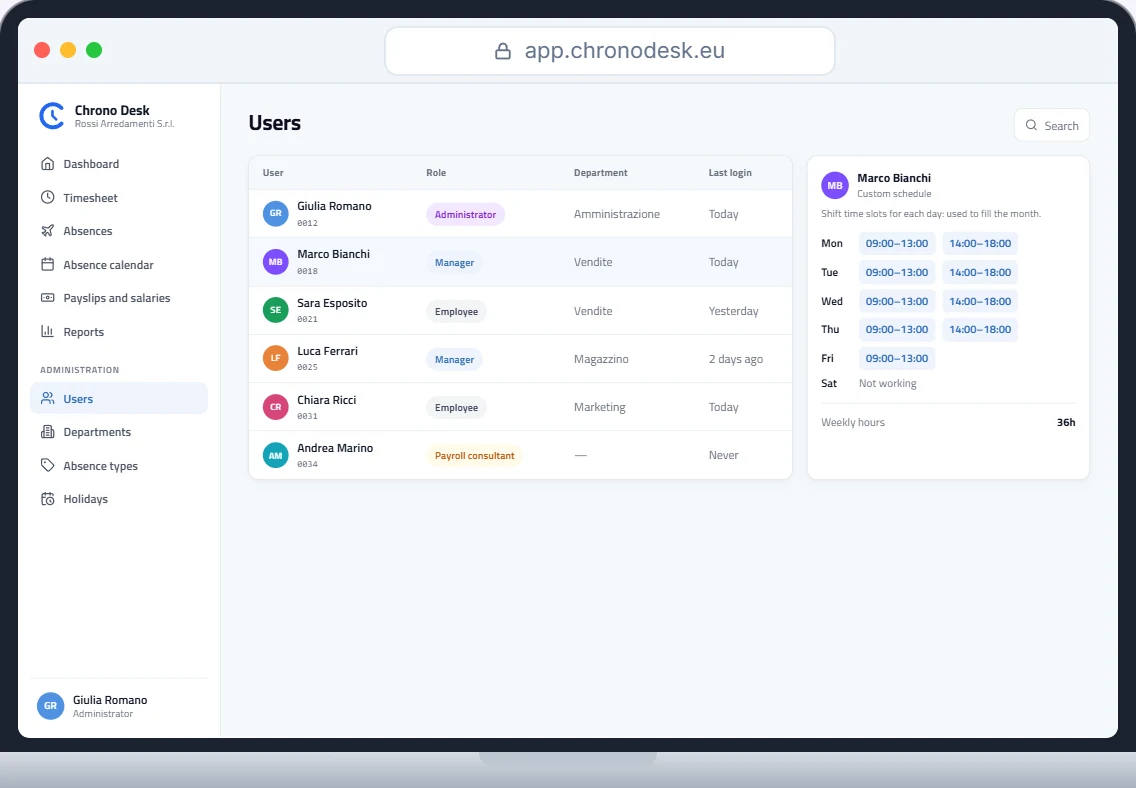
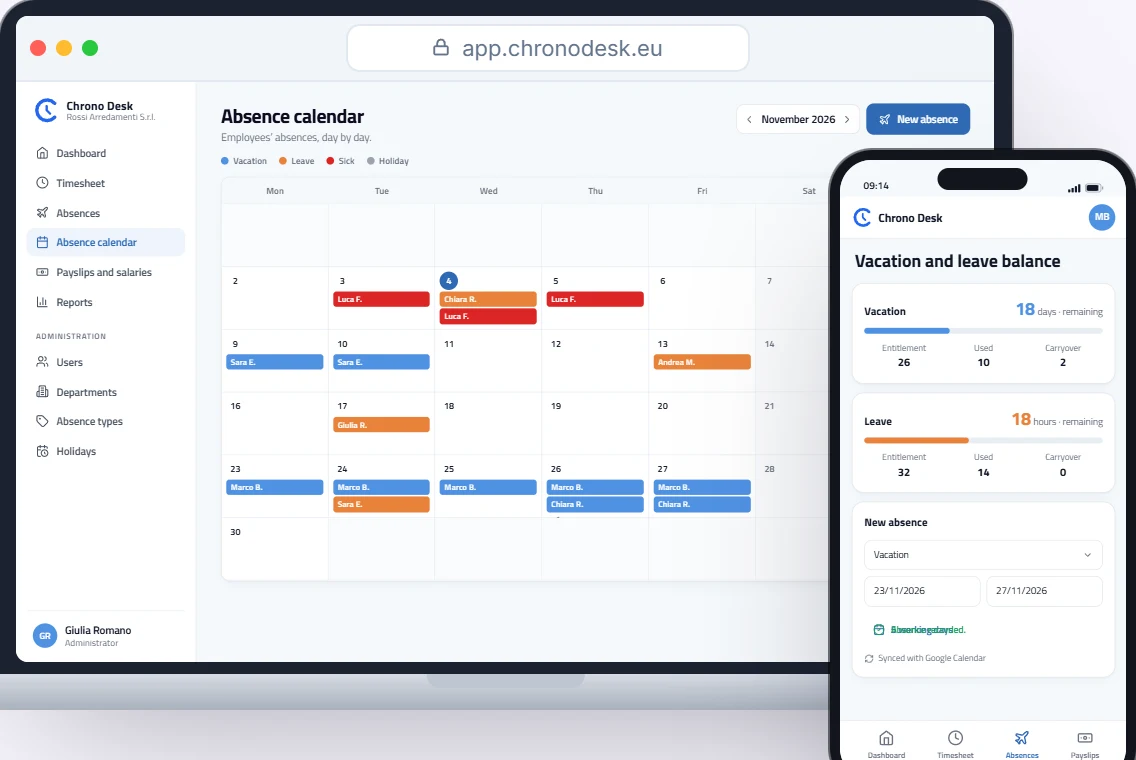
In Chrono Desk the administrator sets the company’s holidays, which appear in the team calendar next to vacation and leave: once you have checked how the CCNL treats the patron saint, you add it like any other holiday. The manager sees who is out on the critical days and can approve leave with coverage in mind. Whoever works on a holiday records the hours in the timesheet, so the payroll consultant finds the data ready to apply the contract’s rules.
Want to see how it fits your collective agreement? Talk to us.
This guide is for information only and does not replace advice from your payroll consultant or the rules of your collective agreement.