Bereavement and family leave in Italy: three paid days and up to two years of unpaid leave
Italy gives 3 paid days for a death or serious illness in the family and up to 2 years of unpaid leave. Who qualifies, documents and how to record it.
Published 4 min read
When an employee loses a relative or looks after one who is seriously ill, Italian law provides two different tools: three days of paid leave and, for longer situations, unpaid leave of up to two years. Keep them separate from vacation, ROL and Law 104 leave.
Paid leave: three days a year
Art. 4, par. 1, of Law 53/2000 gives an employee three working days a year of paid leave (permesso retribuito) on the death or documented serious illness of:
- the spouse, even if legally separated (Ministerial Decree 278/2000, art. 1), and the civil-union partner, because Law 76/2016 (art. 1, par. 20) extends to partners the rules that refer to a “spouse”;
- a relative up to the second degree, even if not living together: parents, children, siblings, grandparents, grandchildren;
- the cohabitant (convivente), provided the stable cohabitation is shown by a registry certificate; the decree also refers to members of the same registered household (famiglia anagrafica).
The text of the law does not expressly mention in-laws (parents-in-law, siblings-in-law): if that case arises, check the CCNL (national collective agreement) or ask your payroll consultant.
How the days are used
The detailed rules are in Decree 278/2000, art. 1:
- the employee must give notice in advance of the event and the days they will use;
- the days must be used within seven days of the death or of the confirmed onset of the serious illness (or of the need for specific therapeutic treatment);
- public holidays and non-working days do not count as leave days;
- for serious illness, employee and employer may agree in writing on different working arrangements, such as reduced hours, even beyond three days; the reduction must start within seven days of confirmation.
This leave can be combined with leave under art. 33 of Law 104 (Decree 278/2000, art. 1): see Law 104 leave in Italy.
Documentation
Under art. 3 of Decree 278/2000:
- serious illness: a certificate from a recognised doctor or facility (a National Health Service or contracted specialist, a general practitioner, a paediatrician, a hospital), handed in within five days of returning to work;
- death: the employee documents it with the death certificate or, where permitted, a substitute declaration. The decree sets no deadline;
- if an alternative working arrangement was agreed, the employer may ask periodically for confirmation of the illness; if the serious illness ends, the employee returns to normal work and unused days can serve for other events in the same year.
Leave for serious family reasons
Art. 4, par. 2, of Law 53/2000 lets public and private employees take leave, continuous or split, of no more than two years for serious and documented family reasons. During the leave:
- the job is kept, but there is no pay and the employee may not do any work;
- the period does not count towards seniority or pension rights; the employee may buy it back by paying contributions on the voluntary-continuation basis;
- Decree 278/2000 (art. 2) says the two years apply over the whole working life, and that how to request and grant the leave is set by collective agreements.
The employer must answer within ten days of the request and may propose a deferral or partial grant only for organisational and production reasons. For a death, if the request is for up to three days, the answer is due within 24 hours. The decree also provides for a notice to the labour inspection service within five days of granting the leave (art. 3).
Do not confuse it with the leave of up to 24 months for oncological or disabling illness of the employee (Law 106/2025, art. 1), which is a separate measure.
The CCNL: more favourable, never less
Art. 4 of Decree 278/2000 says collective agreements may provide more favourable terms. Many CCNLs grant extra days or different rules: read your agreement before replying.
Example: a grandparent dies
A full-timer working Monday to Friday. The grandfather dies on Thursday.
| Day | What happens | Record as |
|---|---|---|
| Thursday | Employee gives notice | Bereavement leave, day 1 |
| Saturday and Sunday | Non-working days | Do not count, no absence |
| Monday | Absent | Day 2 |
| Tuesday | Absent | Day 3, within seven days of the death |
The employee has used the year’s three days.
Mistakes to avoid
- Recording them as vacation or ROL. They are statutory leave and must not use up other balances.
- Not tracking the annual balance. The three days are given “per year”: keep count, bearing in mind the CCNL’s rules.
- Forgetting the seven days. The decree requires the days to be used within that period of the event.
- Losing the documents. Keep the medical or death certificate with the request.
How Chrono Desk does it
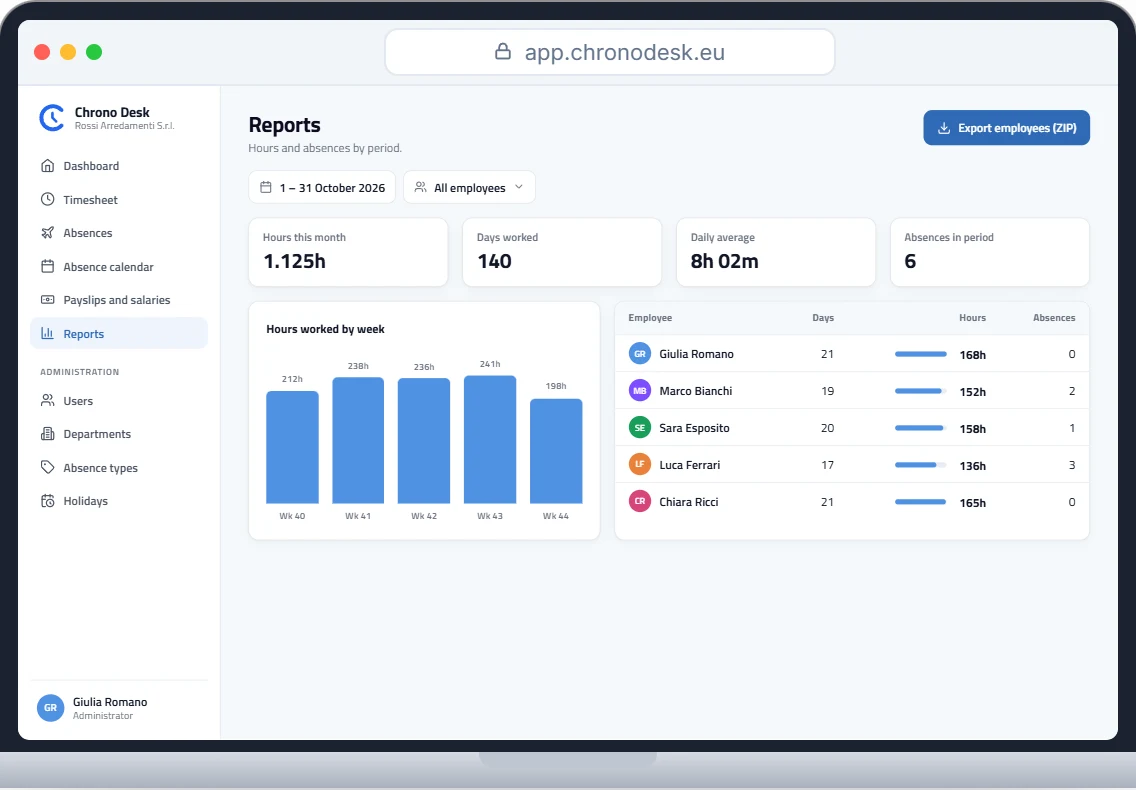
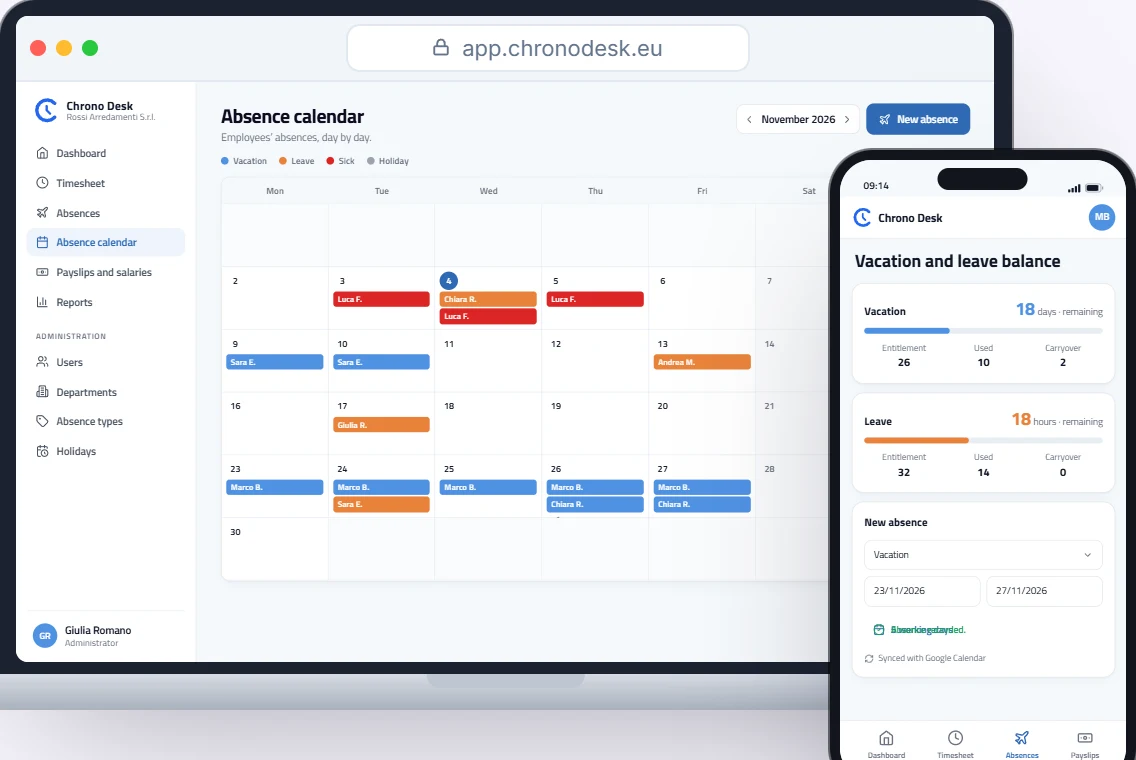
In Chrono Desk you create a dedicated absence type for bereavement and another for leave for serious family reasons, separate from vacation, ROL and Law 104. The employee sends the request from the app, attaches the document and the annual balance updates itself. In the report the absences appear separately, ready for the payroll consultant. For ROL and leave hours see ROL and ex-holiday leave in Italy.
Want to see how it fits your collective agreement? Talk to us.
This guide is for information only and does not replace advice from your payroll consultant or the rules of your collective agreement.