Marriage leave in Italy: who is entitled, how many days and how the INPS allowance works
Marriage leave in Italy: who is entitled, how many days, the INPS allowance for blue-collar staff, civil unions and how to record it in timesheets and payroll.
Published 5 min read
When an employee gets married, or enters a civil union, they usually ask for a few days of marriage leave (congedo matrimoniale). It is not vacation and not ROL: it has its own rules, which depend on the employee’s category, on the collective agreement (CCNL) and, in some cases, on an INPS allowance. Here is how to find your way.
Who is entitled and where it comes from
The leave goes back to a 1937 measure, Royal Decree-Law 1334/1937, which gave office staff (impiegati) an extraordinary leave “not exceeding fifteen days” to marry. INPS, the national social security institute, notes however that this decree has been repealed (Legislative Decree 212/2010) and that the benefit was extended to non-office workers by the inter-confederal collective agreement of 31 May 1941 (INPS message 2951/2023).
According to INPS, today’s position is this:
- blue-collar workers (operai) in industry and crafts: unless collective bargaining provides otherwise, they are entitled to the leave and to the INPS allowance; what counts is the employer’s classification for social security purposes (art. 49, Law 88/1989);
- office staff and all other sectors (commerce, services and so on): the leave is normally provided for by the CCNL. Check your agreement, because days, start date and documents differ from one agreement to another.
How many days
- Blue-collar workers in industry and crafts: INPS describes eight consecutive days of leave, with an allowance paid by the Institute equal to seven days of pay. Many CCNLs add days: check yours.
- Commerce, distribution and services CCNL (Confcommercio), Testo Unico of 3 February 2026, art. 173: an employee who is not on probation is entitled to extraordinary leave of fifteen calendar days. Subject to the company’s needs, the employer grants it starting from the third day before the wedding. The employee must show, at the end of the leave, documents proving the marriage. During the leave they count as in service for all purposes and keep their actual pay (retribuzione di fatto).
Fifteen calendar days include Saturdays, Sundays and public holidays. Other agreements may count differently (calendar or working days) and set another start date: if your CCNL does not say, it helps to agree it in writing with the employee.
The INPS allowance: who advances it and how it is recovered
For the workers it covers, INPS sets out these rules:
- the employer advances the amount and offsets it against the contributions due for the pay period; in the UniEmens monthly return the codes are L051 (marriage leave allowance) and L052 (difference);
- the employee makes the request with at least six days’ notice, except in exceptional cases;
- the employment must have been in place for at least one week;
- the benefit cannot be combined with other pay or pay-replacement benefits for the same period (except the INAIL accident allowance, for the difference); if the CCNL makes the employer pay normal pay anyway, ask your consultant how to handle the recovery;
- it is not due to workers excluded from the CUAF contribution (the family allowance fund);
- if the worker is unemployed and worked at least 15 days as a blue-collar worker in the 90 days before the wedding, the allowance is paid directly: the application goes to INPS within one year of the marriage or civil union date.
Civil, religious and civil-union weddings
INPS grants the benefit “on the occasion of a civil or concordat marriage or civil union” (matrimonio civile o concordatario o unione civile). The allowance is therefore also due for civil unions. For leave provided by the CCNL, Law 76/2016 (art. 1, par. 20) extends to civil-union partners the rules that refer to a “spouse” or to marriage, but it does not mention de facto cohabitation: if the agreement speaks only of “marriage”, ask your consultant how to apply it.
How it differs from vacation and ROL
- Vacation: a legal minimum of four weeks (Legislative Decree 66/2003, art. 10). Marriage leave is a separate absence and should not reduce the vacation balance. See Vacation and leave in Italy.
- ROL and ex-holidays: leave hours set by the CCNL, with their own expiry rules. See ROL and ex-holiday leave in Italy.
- Bereavement and family leave: other statutory leave, to be kept separate. See Bereavement and family leave in Italy.
Example: a Saturday wedding, Commerce CCNL
A full-timer working Monday to Friday, married on Saturday 12 June 2027. The 15 calendar days apply, starting three days before.
| Step | Calculation | Result |
|---|---|---|
| Leave starts | 3 days before Saturday 12 June | Wednesday 9 June |
| Leave ends | 15 calendar days from 9 June | Wednesday 23 June |
| Working days covered | 3 + 5 + 3 (Monday to Friday) | 11 days of leave |
| Weekends and holidays | Saturday and Sunday | No absence to record |
On return the employee hands in the document proving the marriage. No vacation is used.
Mistakes to avoid
- Recording it as vacation or ROL. It is an absence with its own code.
- Assuming 15 days. For blue-collar staff INPS speaks of eight consecutive days: extra days and the start date depend on the CCNL.
- Forgetting the INPS allowance. Where it applies, the advance must be recovered in UniEmens with the right codes.
- Not keeping the document. File the proof of the marriage with the request.
How Chrono Desk does it
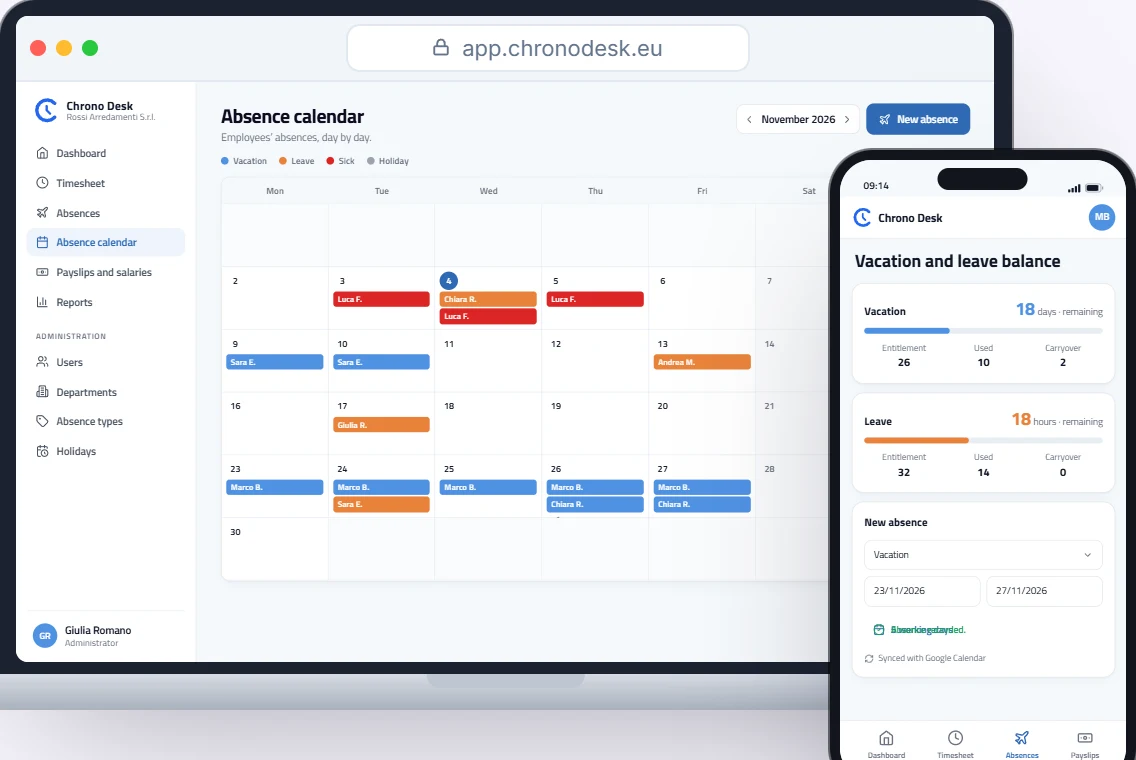
In Chrono Desk you create a dedicated absence type for marriage leave, separate from vacation and ROL. The employee sends the request from the app, attaches the document and the absence appears in the team calendar. In the report the leave is shown separately, ready for the payroll consultant who prepares the payslip.
Want to see how it fits your collective agreement? Talk to us.
This guide is for information only and does not replace advice from your payroll consultant or the rules of your collective agreement.