Part-time work in Italy: hours, vacation and 13th month pay
How part-time works in Italy: written contract, supplementary work and flexibility clauses, vacation, 13th month pay and ROL pro rata, and recording hours.
Published 5 min read
Part-time means hours below full time, but the employee’s rights are not “reduced”: the quantity changes, not the protection. The core rules are in Legislative Decree 81/2015 (arts. 4-12). Here is what the contract must say, how extra hours and schedule changes work, and how vacation, 13th month pay and leave are calculated.
The contract: form and content
- The contract is made in writing as proof (art. 5, par. 1).
- It must state precisely the duration of the work and when the hours fall, by day, week, month and year (art. 5, par. 2). For shift work, a reference to scheduled shifts within set time bands is enough (par. 3).
If there is no proof of a written contract, the employee can ask the court to declare a full-time relationship; if the hours are missing, they can ask for it from the date of the ruling, and compensation is due on top (art. 10). If only the timing of the hours is missing, the judge sets it.
In practice people distinguish horizontal part-time (reduced hours every day), vertical (full hours only on certain days, weeks or months) and mixed. These definitions come from Legislative Decree 61/2000, as the Ministry of Labour reports, and do not appear in arts. 4-5 of Legislative Decree 81/2015: what counts is the schedule in the contract and the collective agreement (CCNL).
Extra hours and schedule changes
- Supplementary work (lavoro supplementare): hours beyond the agreed schedule, within normal working time. If the CCNL does not regulate it, the employer can ask for up to 25% of the agreed weekly hours, with a 15% premium on the overall actual hourly pay; the employee can refuse for documented reasons, such as health, family or training (art. 6, par. 2).
- Overtime: part-timers can work it, as defined in Legislative Decree 66/2003 (art. 6, par. 3).
- Flexibility clauses (clausole elastiche): written agreements that move the timing of the hours or increase their length, in the cases and with the compensation set by collective agreements, with two working days’ notice unless agreed otherwise (art. 6, pars. 4-5). Without a CCNL they must be signed before a certification commission, stating conditions and methods on pain of nullity, with a maximum increase of 25% of annual part-time work and a 15% premium (par. 6).
- Refusal: refusing a flexibility clause is not a valid ground for dismissal (par. 8). Applying one without following the rules exposes the employer to damages (art. 10, par. 3).
Equal treatment and moves to or from full time
Part-timers must not be treated less favourably than comparable full-timers at the same grade: they have the same rights, with pay and conditions scaled pro rata to the reduced hours (art. 7). The CCNL can adjust probation and sick-leave job protection.
On moving between full time and part time (art. 8):
- from full time to part time needs the parties’ written agreement; refusing is not a ground for dismissal;
- employees with serious oncological or chronic-degenerative illness have a right to convert, and the law gives priority in set cases, such as a cohabiting child under 13;
- someone who moved to part time has a right of priority for full-time hires at the same level;
- when hiring part-timers, the employer must promptly inform full-time staff in the same municipality and consider their requests.
Vacation, 13th month pay, TFR and ROL
- Vacation: the minimum is four weeks a year (Legislative Decree 66/2003, art. 10). In horizontal part-time (reduced hours every day) the length is generally the same as full time; in vertical part-time (working only some days) the count in days depends on how the schedule is arranged and on the CCNL: have your labour consultant check it. See Vacation and leave in Italy.
- 13th and 14th month pay: calculated in twelfths of actual pay, so they come out reduced in proportion. See 13th and 14th month pay.
- TFR: accrues on actual pay, as explained in TFR severance pay.
- ROL and ex-holidays: they usually follow the reduced schedule, but the rules are in the CCNL. See ROL and ex-holiday leave.
Example
Monthly pay of a full-timer on 40 hours: €1,800. Someone at the same grade on 20 hours a week over 5 days:
| Item | Calculation | Result |
|---|---|---|
| Share of full time | 20 ÷ 40 | 50% |
| Monthly pay | €1,800 × 50% | €900 |
| Minimum annual vacation | 4 weeks × 20 hours | 80 hours (20 days of 4 hours) |
| 13th month pay, 12 months | €900 ÷ 12 × 12 | €900 |
These are indicative gross figures: the CCNL may set different terms.
FTE and headcount
When a rule depends on the number of employees, part-timers are counted in proportion to the hours worked compared with full time (art. 9). That is the idea behind FTE (full-time equivalent): 20 hours out of 40 is 0.5 FTE. For your own team use the FTE calculator.
Recording hours
Record the actual hours every day, so that the contract hours and the hours beyond the agreed schedule (supplementary work) are visible. Supplementary work has its own premium and limits, different from overtime. The single employment register (LUL) lists hours day by day, with unambiguous codes (Decree-Law 112/2008, art. 39). See also employee timesheets.
Mistakes to avoid
- A contract with no precise schedule, or not in writing. You risk a full-time declaration.
- Extra hours paid as normal hours. Beyond the agreed schedule, the supplementary work rules apply.
- Flexibility clauses without the required conditions and notice.
- Vacation always counted in days. With different schedules, the hours calculation matters too.
How Chrono Desk does it
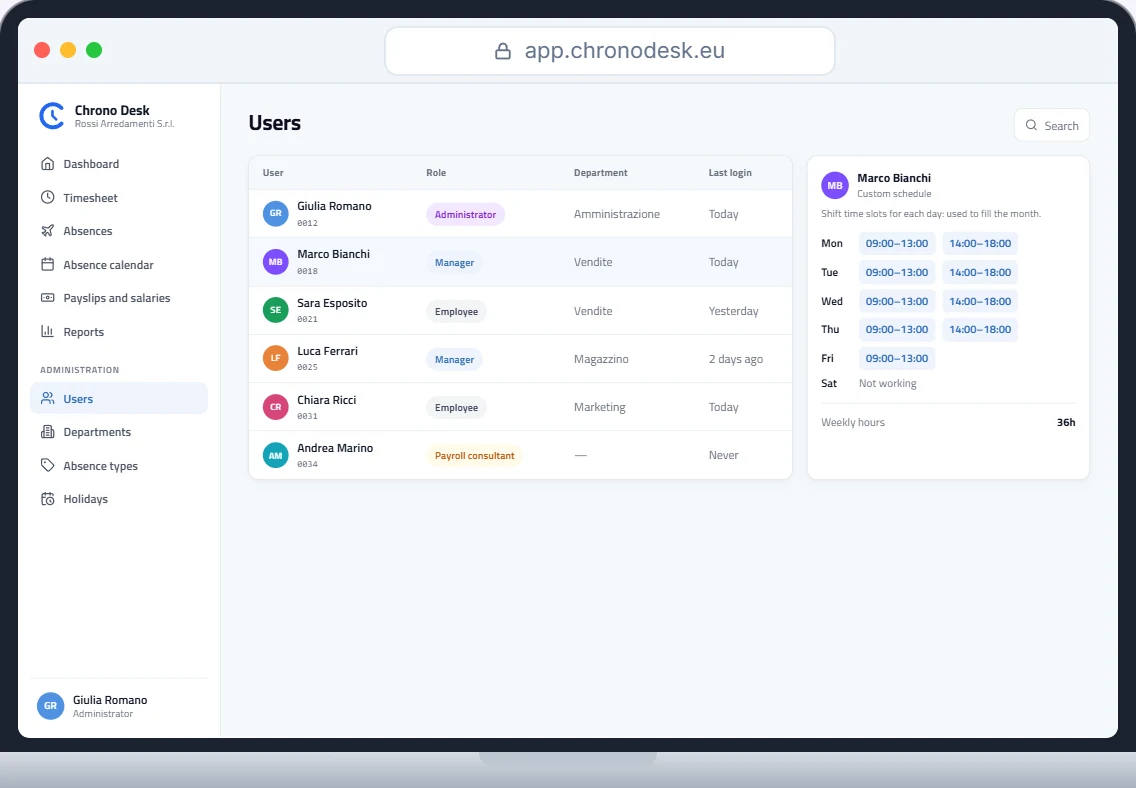
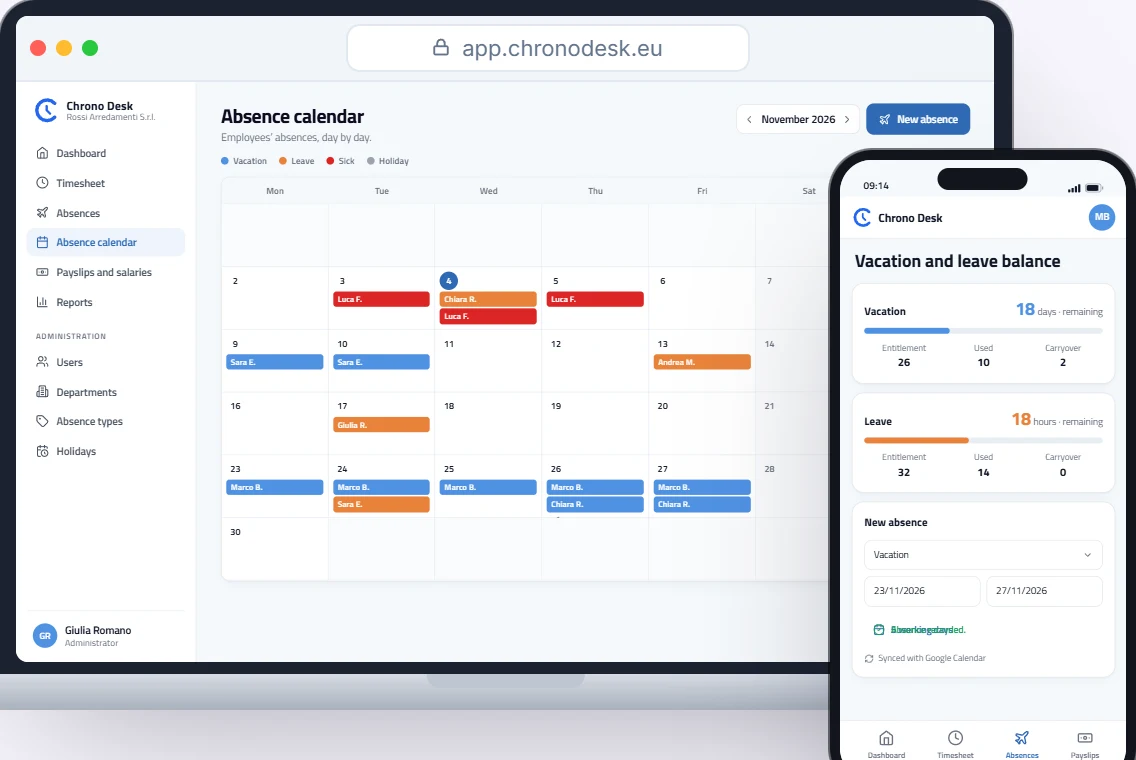
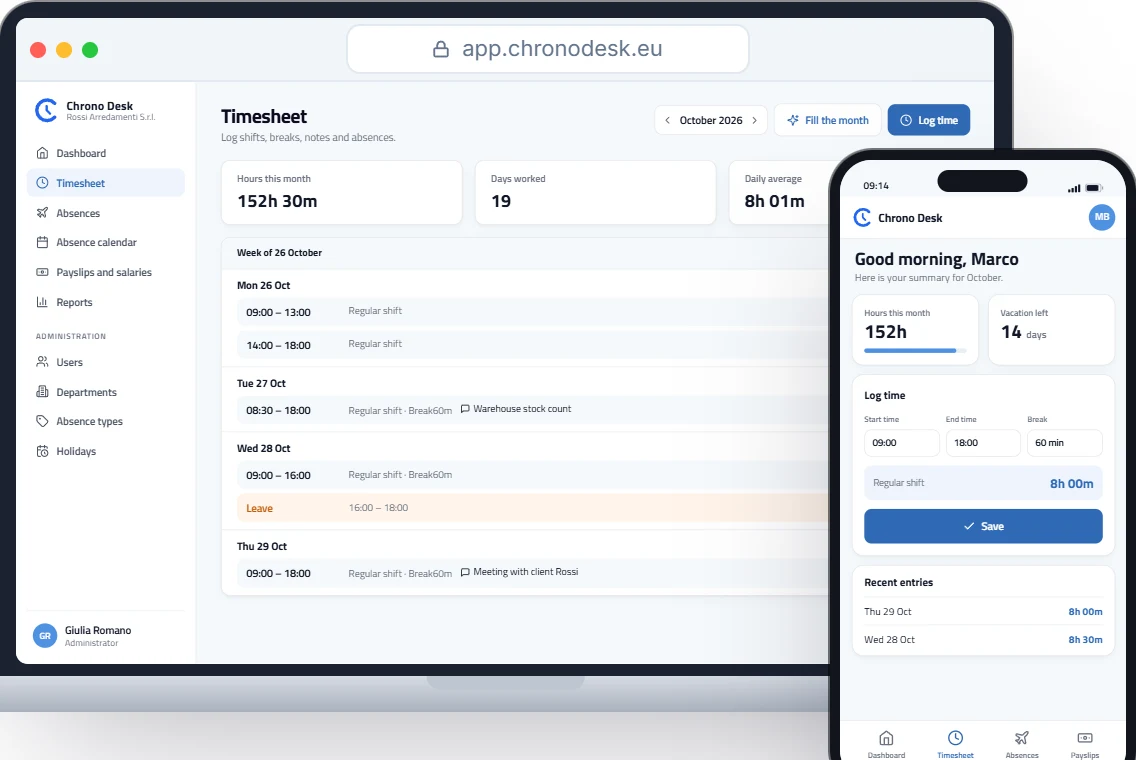
In Chrono Desk you set contract, weekly hours and a personal schedule with each day’s time bands for every employee. Hours and vacation and leave, tracked in days or hours, sit in the same place, and the payroll consultant finds everything in the reports.
Want to see it with your part-timers? Talk to us.
This guide is for information only and does not replace advice from your payroll consultant or the rules of your collective agreement.