Italy's Commerce CCNL (Confcommercio): hours, flexibility, overtime and leave
Italy's Commerce CCNL (Confcommercio, 2026 text): 40-hour week, flexibility and time bank, overtime premiums, ROL, vacation and sick leave, with an example.
Published 5 min read
The Terziario, distribuzione e servizi collective agreement (CCNL) signed by Confcommercio, usually called the Commerce CCNL, covers shops, offices and service companies. For anyone tracking hours, about ten articles matter. We summarise them with references to the text.
Which text we read
The articles cited come from the CCNL Testo Unico (consolidated text) of 3 February 2026 (CNEL code H011), in the version published by Confcommercio. It brings together the 2019 Testo Unico, the renewal of 22 March 2024 and the later agreements, and its numbering differs from earlier texts: the same rule has a different number. In the 2024 text, for example, paid leave (permessi retribuiti) is art. 158, not 161. With an old PDF the references will not match: always check the text in force.
Normal hours and how they are spread
- 40 hours a week of actual work (art. 133; Legislative Decree 66/2003, art. 3, par. 1). Within the week, the employer may ask for days longer than 8 hours.
- What is not actual work: travel time to work, intermediate rest breaks and pauses between the start and end of the daily schedule (art. 133).
- 39 or 38 hours: in some companies the week is shorter because paid leave hours are absorbed into it (art. 136, letters b and c; art. 137 for department stores, supermarkets and hypermarkets). Hours beyond the shorter schedule, up to 40, are paid with the art. 152 premiums (art. 138).
- Changing the schedule: employees must be told at least 30 days ahead, and a schedule normally holds for a year (art. 139).
- 48-hour limit: the weekly average, overtime included, is measured over six months, extendable to twelve by second-level bargaining for objective reasons (art. 134). The statute says four months (Legislative Decree 66/2003, art. 4, par. 3).
Flexibility and the time bank
Art. 140 lets a company exceed normal hours in peak periods, up to 44 hours a week for at most 16 weeks, on these conditions:
- for the extra hours the company grants, during the year and in quieter periods, an equal amount of time off;
- pay stays that of the contractual hours, both in the longer and in the shorter weeks;
- the programme is communicated in writing, and changes need 15 days’ notice;
- at the end of the programme, hours worked and not made up are paid with the overtime premium (art. 152), within the art. 151 limits.
Local or company agreements can go up to 48 hours a week, with extra paid leave (arts. 141-142): 50% of the hours to be made up go into the time bank (banca delle ore, art. 144; see the guide). Time off is normally taken in blocks of 4 or 8 hours with 5 days’ written notice, and on 31 December the company gives the employee an individual statement. Hours not taken are paid with the overtime premium by 31 December of the following year (art. 143).
Overtime: limits and premiums
Overtime is work beyond the normal hours of art. 133. The individual limit is 250 hours a year, and the employee may not work overtime without authorisation from the employer or its representative (art. 151). It must be entered chronologically in the single employment register (Libro Unico del Lavoro) and paid by the following month (art. 153).
| Overtime hours | Premium |
|---|---|
| From the 41st to the 48th hour of the week | 15% |
| Beyond the 48th hour of the week | 20% |
| On public holidays or Sundays | 30% |
| At night, 10 pm to 6 am, outside regular shifts | 50% |
Premiums cannot be combined (art. 152). Each hour is paid at the hourly rate of actual pay (retribuzione di fatto, art. 212), while the percentage is calculated on the hourly rate of normal pay (normale retribuzione, art. 210). The divisor is 168 for the 40-hour week and 26 for the daily rate (arts. 214-215): see hourly rate and divisor.
Leave, sick leave and special leave
- ROL and ex-holiday leave (art. 161): blocks of 4 or 8 hours for the four abolished holidays, plus leave of up to 56 hours a year (72 above 15 employees). Hours not taken are paid or can be taken by 30 June. Details in the guide on ROL.
- Vacation (art. 162): 26 working days, counting a six-day week from Monday to Saturday whatever the schedule; Sundays and holidays falling in the period are not counted. It can be split into no more than two periods, and sickness during it interrupts it (art. 163).
- Sick leave: job protection (comporto) of 180 days in a calendar year (art. 190). The employer tops up the INPS allowance (art. 191): for the first three days the top-up falls from the third episode of the year and stops from the fifth.
- Marriage leave: 15 calendar days (art. 173), explained in this guide.
Example: three kinds of overtime in a month
Full-timer on 40 hours. Normal monthly pay of €1,680, actual pay of €1,848 (including a superminimum). Divisor 168.
| Item | Calculation | Gross amount |
|---|---|---|
| Hourly rate, normal / actual | €1,680 ÷ 168 / €1,848 ÷ 168 | €10.00 / €11.00 |
| 6 hours from the 41st to the 48th | 6 × (€11.00 + 15% of €10.00) | €75.00 |
| 2 night hours | 2 × (€11.00 + 50% of €10.00) | €32.00 |
| 4 Sunday hours | 4 × (€11.00 + 30% of €10.00) | €56.00 |
| Total | €163.00 |
Made-up, indicative figures: the payroll consultant applies the real items.
Mistakes to avoid
- Using an old text. Articles have been renumbered: check the edition.
- Applying the percentage to actual pay only. The CCNL uses two bases.
- Counting breaks and travel as actual work. Art. 133 excludes them.
- Forgetting flexibility hours not made up. At the end of the programme they are paid as overtime.
- Mixing the time bank and ROL. Different origins, balances and deadlines.
How Chrono Desk does it
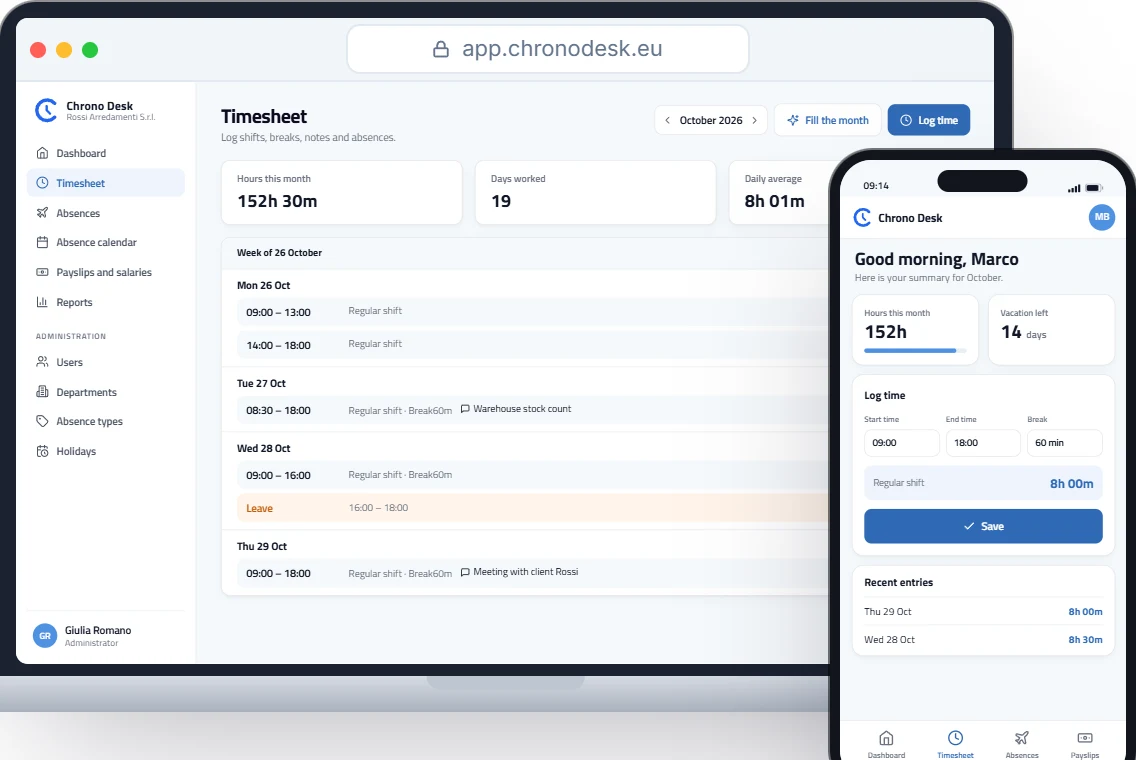
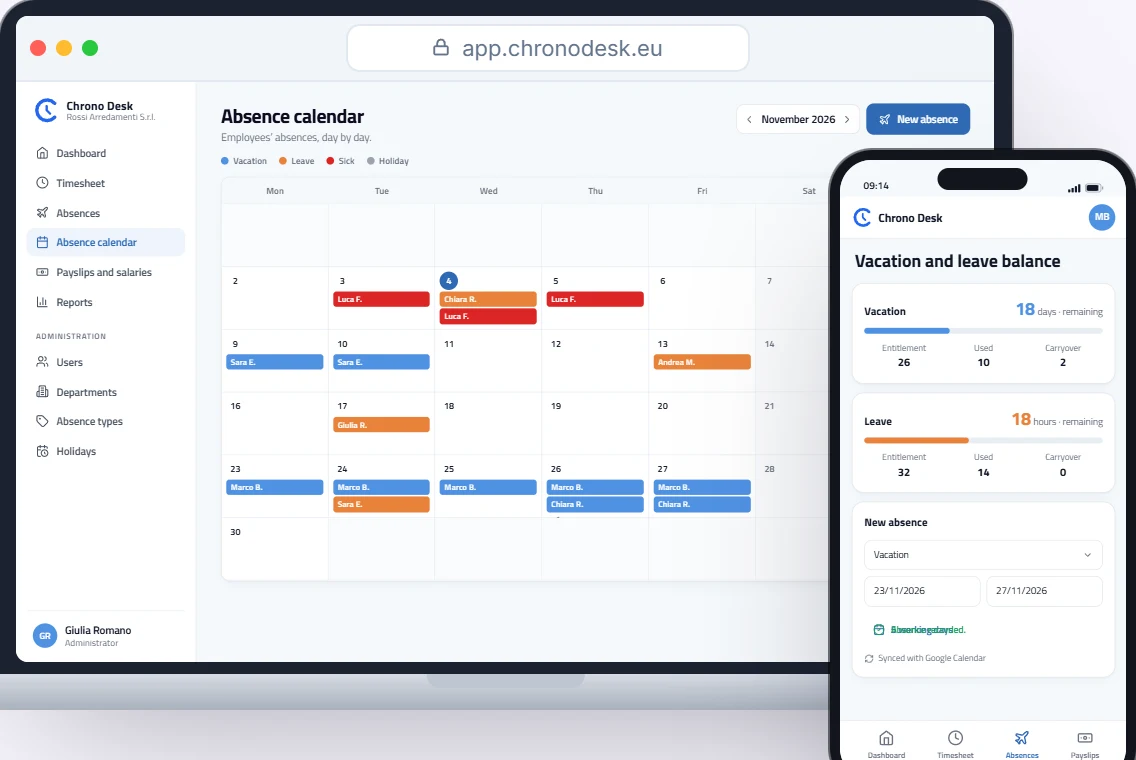
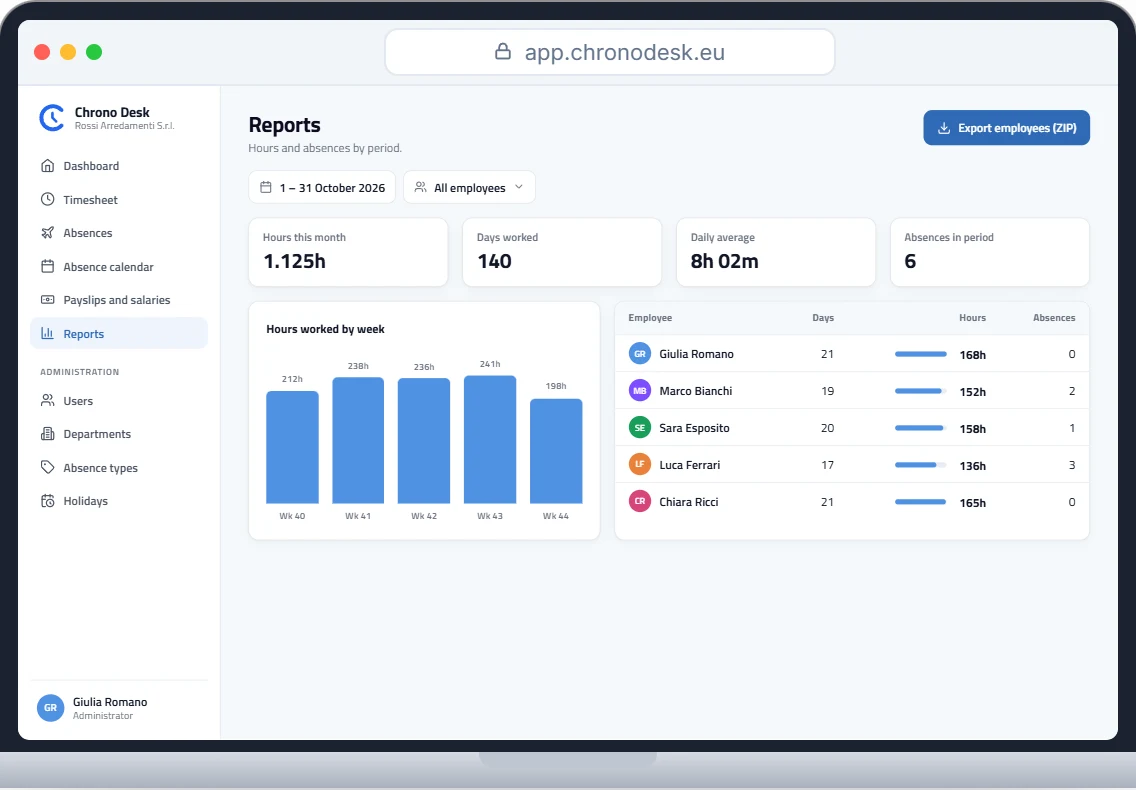
In Chrono Desk hours are recorded every day with start, end and break, so you can tell actual work from pauses. With vacation and leave you create your own absence types, such as ROL, ex-holiday leave and marriage leave. In the report the payroll consultant finds hours and absences per employee, from which they apply the agreement’s premiums.
Want to see how it fits your collective agreement? Talk to us.
This guide is for information only and does not replace advice from your payroll consultant or the rules of your collective agreement.