Working on public holidays in Italy: national holidays, rules and pay
Which days are Italian public holidays, what happens when they fall on a Sunday, how holiday work is paid and what the CCNL decides, with a worked example.
Published 5 min read
Christmas, 25 April, 1 May: every year the same questions come back. Who can work on public holidays? How are people paid when they work, and when they stay home? And what if the holiday falls on a Sunday? The answer is partly in the law and partly in the collective agreement (CCNL): here is what each one says.
Which days are national holidays
The list of public holidays (giorni festivi) is in art. 2 of Law 260/1949, as amended. Today the days are:
- every Sunday;
- 1 January and 6 January (Epiphany);
- Easter Monday (Pasquetta);
- 25 April and 1 May;
- 2 June;
- 15 August;
- 4 October, St Francis of Assisi, from 1 January 2026 (Law 151/2025, arts 1 and 3);
- 1 November;
- 8 December;
- 25 and 26 December.
The amendments matter. Law 54/1977, art. 1, ended the civil holiday status of St Joseph, Ascension, Corpus Domini and Saints Peter and Paul, and moved 2 June and 4 November to the Sunday. Epiphany became a holiday again with Presidential Decree 792/1985, and 2 June with Law 336/2000 (from 2001). Saints Peter and Paul (29 June) is a holiday in Rome only (Presidential Decree 792/1985, art. 1). For this reason 4 November is not among today’s calendar holidays: check with your consultant how your contract treats it.
The local patron saint
The patron saint’s day is a local holiday and is not in the list in art. 2. How it is treated on the payslip is decided by the CCNL: the law mentions it only among the days that collective agreements may treat as holidays (Law 90/1954, art. 2).
Who works on public holidays
Law 260/1949 does not expressly say who must or may work on a public holiday: it regulates what is due to those who do. So the answer depends on the CCNL and on individual agreements, and there are several court rulings on an employee’s refusal, which look at the specific case. Before a disciplinary charge against someone who refuses, talk to your payroll consultant.
How holiday work is paid
The basic rule is art. 5 of Law 260/1949, in the text replaced by Law 90/1954 (art. 1). It covers 2 June, 25 April and 1 May (the text also names 4 November):
| Situation | What is due |
|---|---|
| Paid by the hour, does not work | The normal daily retribuzione globale di fatto (actual total pay), calculated on one sixth of the weekly hours in the contract |
| Works (paid by the hour or on fixed pay) | The normal daily pay plus the hours worked, with the holiday-work premium |
| The holiday falls on a Sunday | An extra payment equal to the daily rate |
Law 90/1954, art. 3, extends these rules to all the holidays in art. 2, but only for employees of private employers paid by the hour, and not for Sundays. For people on a fixed monthly salary, and for the premium percentages, the CCNL rules apply: the law sets no percentages. More favourable terms in collective agreements always stand (art. 4).
Holidays on a Sunday or a day off
- On a Sunday: for 2 June, 25 April and 1 May the extra daily payment is due. The entitlement also stays due if the employee is idle because the holiday coincides with a Sunday or with another day the CCNL treats as a holiday (Law 90/1954, art. 2).
- On another rest day, such as the Saturday of someone on a five-day week: the law does not regulate it, the CCNL does. Check whether it provides an allowance or a leave day.
Holidays, weekly rest and ex-holiday leave
These are three different things:
- Public holiday: a day that is a holiday by law, with the pay rules above.
- Weekly rest: every seven days at least 24 consecutive hours of rest are due, normally on Sunday, calculated as an average over a period of no more than 14 days (Legislative Decree 66/2003, art. 9). Working on a public holiday does not replace it.
- Ex-holiday leave (ex festività): the paid leave that agreements granted in exchange for the holidays abolished in 1977. It is counted in hours and depends on the CCNL: see our guide to ROL and ex-holiday leave.
Example: a holiday worked
An hourly-paid employee, 40 hours a week over five days, hourly rate of €10.00 (an indicative figure). They work 8 hours on 1 May. The CCNL sets the holiday premium: we call it m.
| Step | Calculation | Result |
|---|---|---|
| Hours of normal daily pay | 40 ÷ 6 | 6.67 hours |
| Normal daily pay | 6.67 × €10.00 | €66.67 |
| Hours worked with premium | 8 × €10.00 × (1 + m) | depends on the CCNL |
The gross total is the sum of the two lines. For the hours with a premium you can use the overtime pay calculator with your CCNL’s percentage. If the hours go beyond standard hours, see also our guide to overtime.
Mistakes to avoid
- Trusting a generic list. Check the holiday and the year: from 2026 there is also 4 October, and the patron saint depends on the municipality.
- Applying a standard premium. The percentages are in the CCNL, not in the law.
- Imposing holiday work without an agreement. Check the CCNL and individual agreements before penalising a refusal.
- Not recording holiday hours. The single employment register (LUL) lists hours, overtime and absences day by day (Decree-Law 112/2008, art. 39): see our guide to attendance records.
How Chrono Desk does it
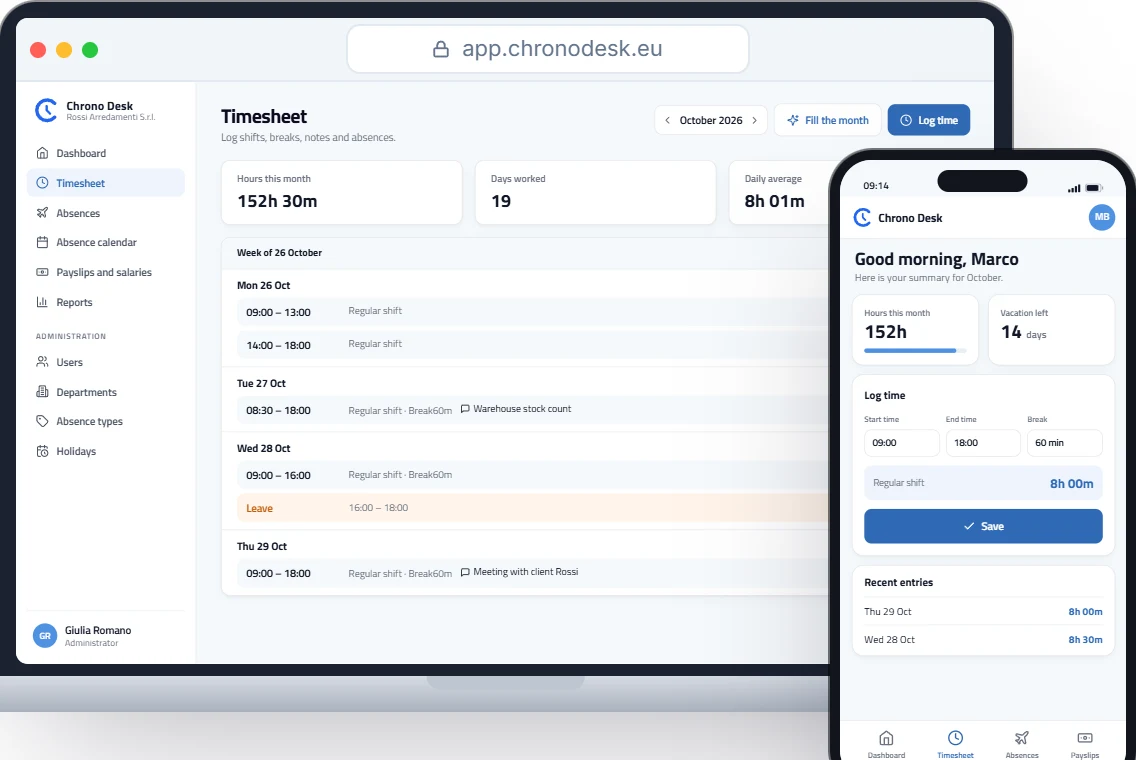
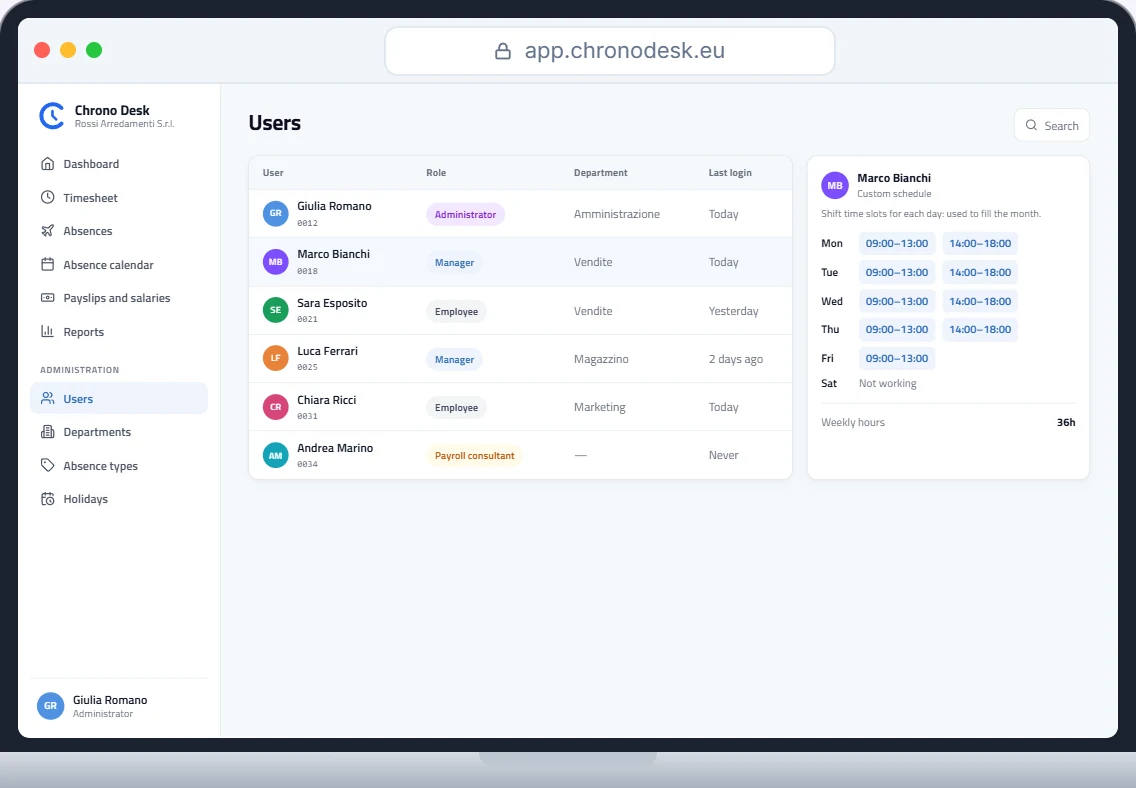
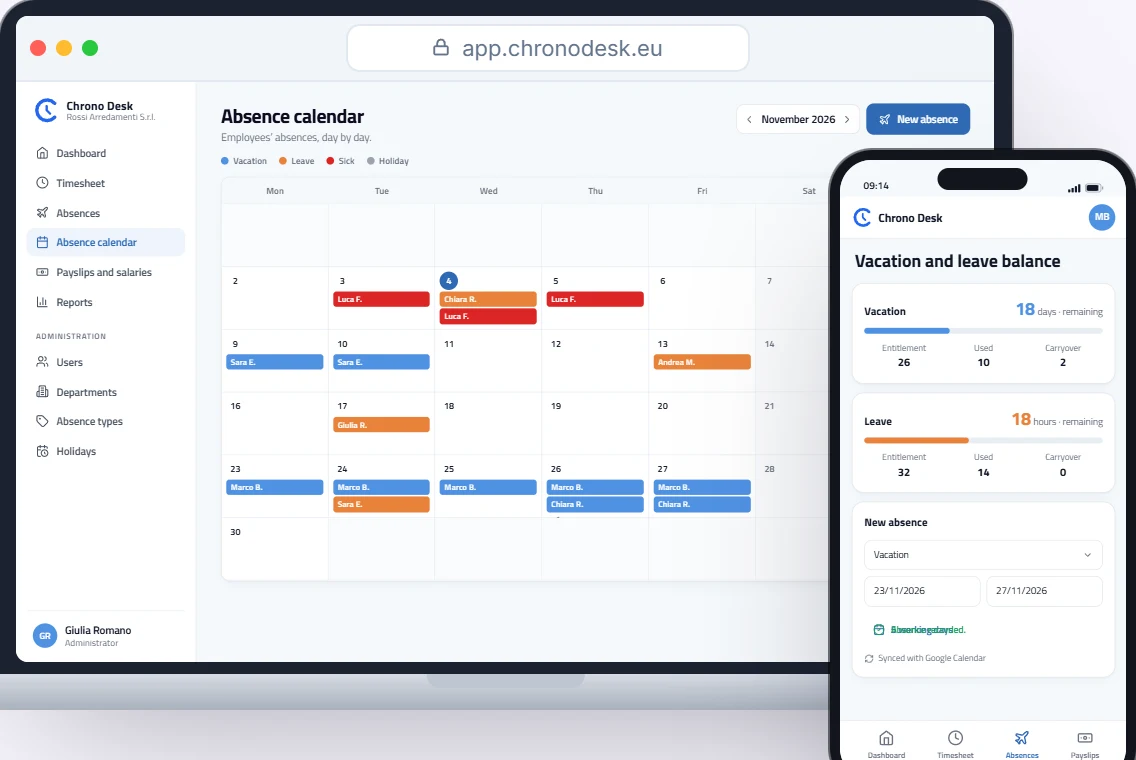
In Chrono Desk you set your company’s public holidays, and they show in the calendar next to vacation and leave. Whoever works on a holiday records the hours every day in the timesheet, with start, end and break, so the payroll consultant finds the data ready to apply the CCNL’s premiums. The dates of the year’s holidays, with Easter and Easter Monday, are in the public holidays calendar.
Want to see how it fits your collective agreement? Talk to us.
This guide is for information only and does not replace advice from your payroll consultant or the rules of your collective agreement.