Digital payslips and traceable salaries in Italy: what employers must know
Can payslips be delivered as PDFs? What Italian law requires for payslip delivery and traceable salary payments, and how to simplify the whole monthly process.
Published 3 min read
Every month, in every company, the same thing happens: the payroll consultant prepares payslips, someone hands them out and then salaries are paid. Simple steps, but with precise rules. Here is what they are and how to make the process faster and safer.
Payslips are mandatory
Italian Law 4/1953 requires employers to give workers a pay statement (prospetto paga), the payslip, when wages are paid. It must show, among other things, the worker’s details, the period, the pay items and the deductions.
Since 2008 the payslip has been linked to the Libro Unico del Lavoro (LUL), Italy’s single employment register (art. 39 of Decree-Law 112/2008): the payslip an employee receives is often simply their extract of the LUL.
Can payslips be delivered as PDFs?
Yes. The law does not require paper: payslips can be delivered electronically, as long as the employee actually receives them and can keep and print them. It is good practice to tell employees how payslips will be delivered and to be able to show they were.
How you deliver them matters, though:
- One email per employee, forwarded by hand, is slow and error-prone: one wrong recipient and someone’s personal and salary data goes to the wrong person.
- A shared folder risks giving everyone access to every payslip.
- A platform where each person sees only their own payslip, with a notification when it’s ready, solves both and records who downloaded it.
Payslips contain personal data protected by the GDPR: only the employee concerned and those who handle payroll should see them.
Salaries must be paid traceably
Since 1 July 2018 (Law 205/2017, art. 1, paragraphs 910‑914) paying salaries in cash is banned. Wages and advances must be paid by:
- bank transfer to the worker’s account;
- electronic payment instruments;
- cash at the bank or post office counter where the employer has a treasury account with a payment mandate;
- cheque handed to the worker (or to a delegate if they can’t collect it).
The ban covers all employment relationships, whatever their length or contract type, as well as coordinated freelance contracts (co.co.co.) and worker-members of cooperatives. Public administration and domestic work are among the exclusions.
Paying in cash can cost a fine of €1,000 to €5,000. And note: the worker’s signature on the payslip does not prove payment. Traceable payment matters as much as the payslip itself.
The problem with one transfer per employee
Many small businesses pay salaries with one transfer per employee from online banking. Every month that means copying net amounts from payslips, double-checking every IBAN, typing a reference for each and hoping nobody was missed. With ten employees that’s half a morning, and a typo in an amount or IBAN can be costly.
A simpler flow
The ideal process has a few clear steps:
- the payroll consultant uploads payslips directly, without going through the company’s inbox;
- each employee gets a notification and downloads only their own payslip;
- admins see who has downloaded theirs;
- salaries are paid together in a single batch, with amounts and reference, and money only moves after an approval.
How Chrono Desk does it
Chrono Desk follows exactly this flow:
- the payroll consultant has a dedicated role and uploads payslips as PDFs;
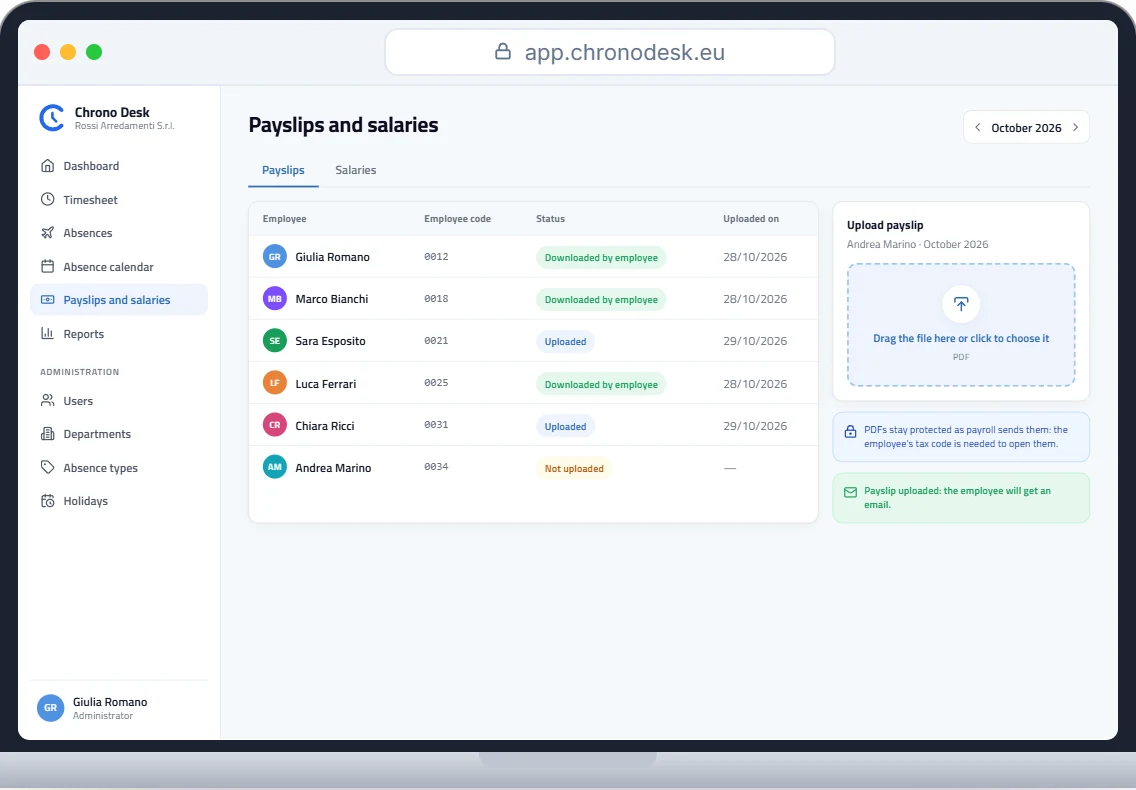
- each employee gets an automatic email and downloads their own payslip; PDFs stay protected as payroll sends them, opened with the employee’s tax code;
- you see each payslip’s status: uploaded or downloaded by employee;
- you enter the month’s amounts and pay every salary from the company RoxPay account in one batch; money only moves after approval on RoxPay, and everything is traceable;
- the salary lands in the employee’s RoxPay wallet and, if they want, goes on automatically to their bank account.
Want to close the month in a few clicks? Request a demo. For the step before, read the guide on employee timesheets.
This guide is for information only and does not replace advice from your payroll consultant.