Night work in Italy: who is a night worker, limits, health checks and premiums
Who is a night worker under Legislative Decree 66/2003, the 8-hour limit, health checks, exclusions and CCNL premiums, and how to record night hours.
Published 4 min read
People who work at night have extra rules: a limit on hours, health checks and, usually, a premium on the payslip. The first step is to understand who really counts as a night worker and what the law decides versus what the collective agreement (CCNL) decides.
What counts as night and who is a night worker
Legislative Decree 66/2003, art. 1, par. 2, gives two definitions.
- Night period: a period of at least seven consecutive hours that includes the interval between midnight and 5 a.m.
- Night worker: someone who works at least three hours of their daily working time during the night period, in the normal way. Or someone who works part of their schedule at night as defined by collective agreements; where the agreement says nothing, someone who does night work for at least 80 working days a year, a threshold reduced pro rata for part-timers.
So the law does not fix exact hours (for example 10 p.m. to 6 a.m.): the band that earns the payslip premium is usually the one written in the CCNL.
Hours limits and protections
- Maximum hours (art. 13): a night worker’s hours may not exceed eight hours on average in 24 hours. Collective agreements may set a longer period over which to calculate the average. For work involving particular risks or heavy physical or mental strain, identified by a ministerial decree, the limit is eight hours in every 24-hour period: ask your consultant whether your activity falls under it.
- Health checks (art. 14): the health assessment of night workers is carried out at the employer’s expense, with preventive and periodic checks at least every two years, to rule out contraindications to night work.
- Protective measures (art. 14): during night work the employer must provide prevention and protection measures equivalent to those for day shifts.
- Union consultation (art. 12): before introducing night work the employer consults the company union representatives, if any, under the criteria of the collective agreement; otherwise the territorial worker organisations. The consultation is completed within seven days.
- Unfitness (art. 15): if a competent doctor or a public health facility certifies that the worker is no longer fit for night work, the employer assigns them to equivalent day duties, if they exist and are available. The collective agreement covers cases where this is not possible.
Who cannot or need not work nights
Art. 11, par. 2, provides that:
- women may not be assigned to work between 24:00 and 06:00 from confirmation of pregnancy until the child turns one;
- the following are not obliged to work nights: the mother of a child under three (or, alternatively, the cohabiting father), the sole custodial parent of a cohabiting child under twelve, an adoptive or foster mother or father in the first three years after the child joins the family (and no later than the child’s twelfth birthday), and anyone caring for a person with a disability under Law 104/1992.
Unfitness may be certified by the public health facilities (art. 11, par. 1). For minors, which this guide does not cover, check with your payroll consultant.
Premiums are set by the CCNL
The law gives no percentages. Art. 13, par. 2, leaves collective agreements free to provide reduced hours or pay premiums for night work. The percentage, the time band and the rules for night overtime vary from agreement to agreement and change with renewals: always check the text of your CCNL. For overtime see our guide to overtime rules.
How to record night hours
The single employment register (Libro Unico del Lavoro, LUL) lists each day’s hours worked and the overtime hours (Decree-Law 112/2008, art. 39, par. 2). Night hours are not named there, but you need them to apply the CCNL. That is why it helps to keep them separate from day hours.
Example with indicative values: a shift from 21:00 to 05:00, with the CCNL’s night band running from 22:00 to 06:00.
| Band | Time | Hours |
|---|---|---|
| Regular day hours | 21:00–22:00 | 1 |
| Night hours | 22:00–05:00 | 7 |
| Shift total | 8 |
The 7 night hours exceed the three hours in the legal definition, so someone who works this shift regularly is a night worker. The premium set by the agreement applies to those 7 hours. To work out the length of a shift between two times you can use the hours between two times calculator.
Mistakes to avoid
- Assuming the night band. The one that counts for payroll is in the CCNL.
- Not keeping night hours separate from day hours and overtime.
- Forgetting the periodic health checks for night workers.
- Assigning nights to people who cannot do them or are not obliged to: check pregnancy, young children and care of people with disabilities.
- Overlooking shifts that only partly touch the night. Even a few hours in the night band should be recorded separately.
How Chrono Desk does it
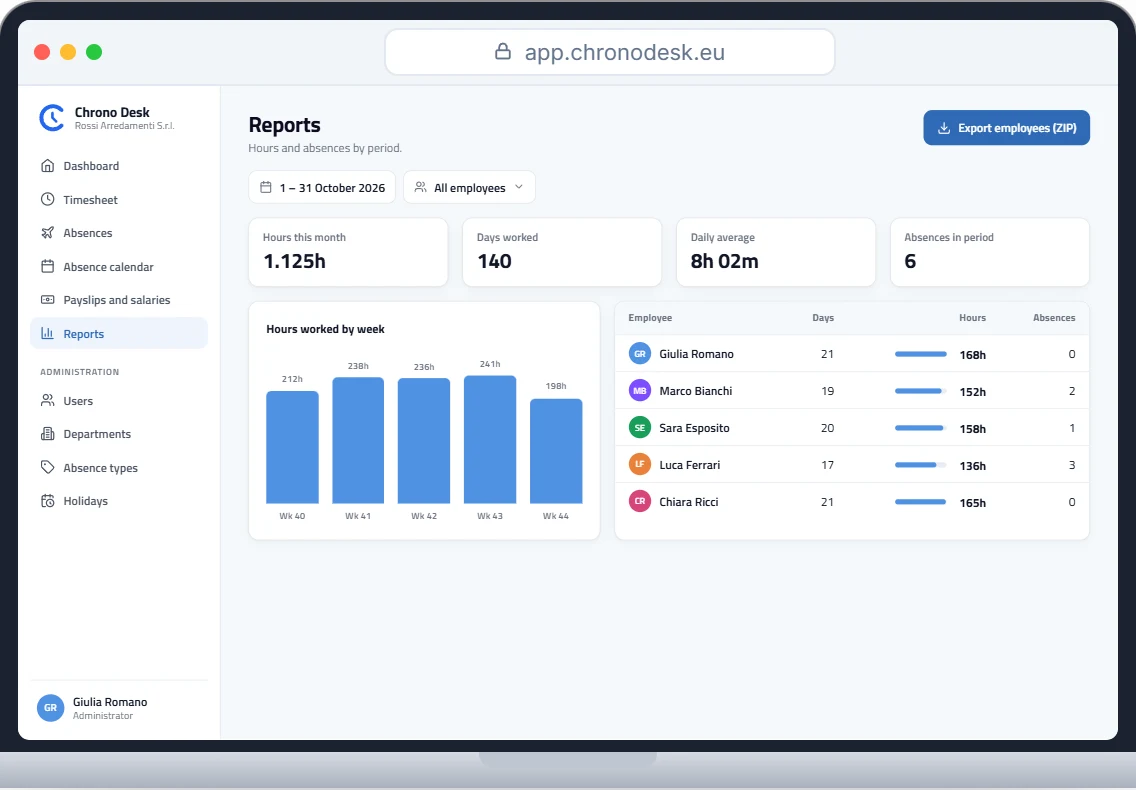
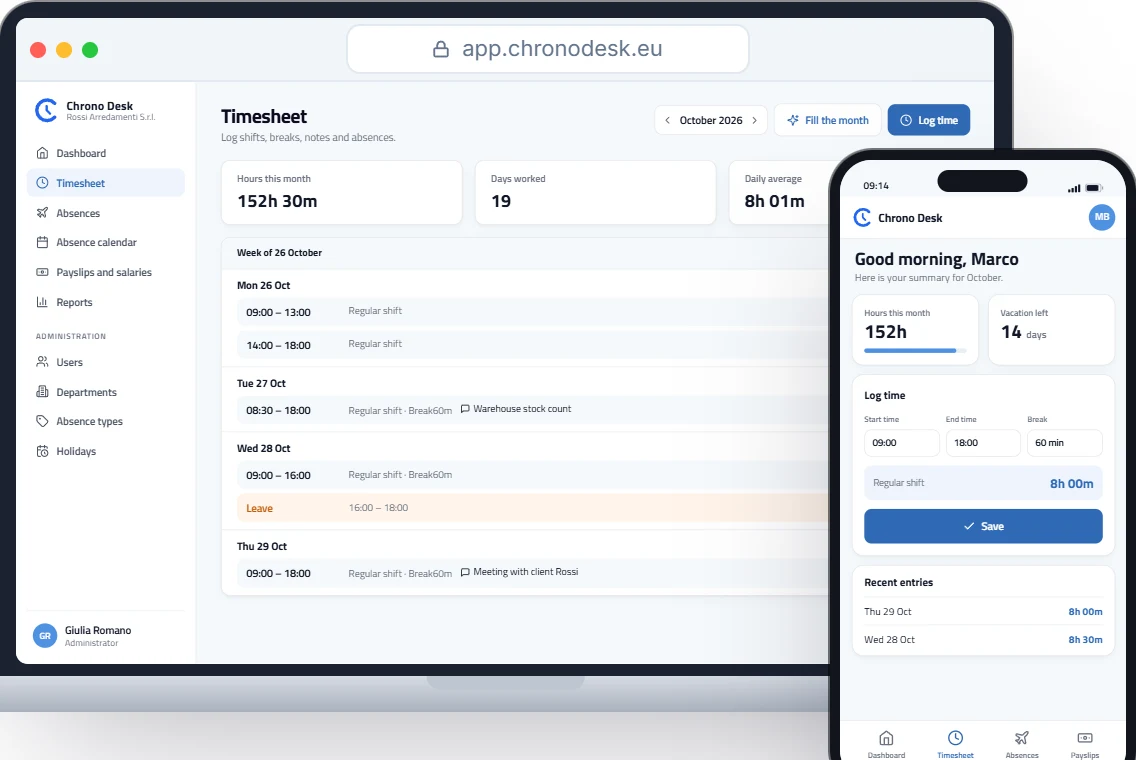
In Chrono Desk employees record start, end and break every day. In the reports hours are summarised by employee and by period, and the payroll consultant downloads the data to apply the agreement’s premiums.
Want to see how to manage your company’s night shifts? Talk to us.
This guide is for information only and does not replace advice from your payroll consultant or the rules of your collective agreement.